
Online learning has become more popular than ever, and with hundreds of platforms available, it can be hard to tell which ones are truly worth your time and money. Study.com is one of the most talked-about options, offering everything from K-12 subjects and college-level courses to test prep and career training. It promises a flexible, affordable way to learn at your own pace through short video lessons, interactive quizzes, and progress tracking tools.
But how does it actually perform in real life? Can you really earn college credit through Study.com? And is the content engaging enough to keep you motivated over the long term? These are the kinds of questions most learners ask before investing in an online learning platform.
In this in-depth review, we’ll look closely at Study.com’s features, course quality, pricing, strengths, and limitations based on real user feedback and expert opinions. Whether you’re a student trying to boost your grades, a professional hoping to pick up new skills, or someone aiming to earn credits toward a degree, this guide will help you decide if Study.com is the right fit for your goals.
Overview of Study.com
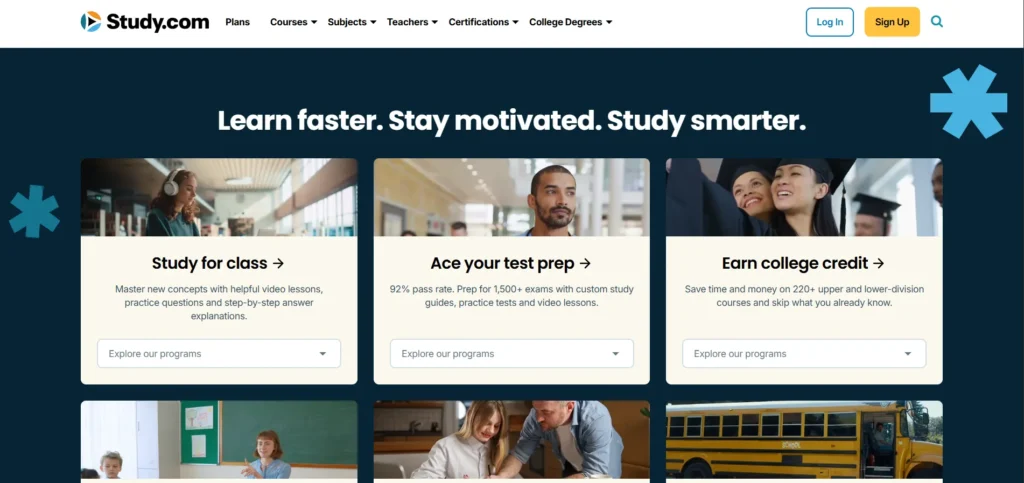
Study.com is an online learning platform that caters to a wide range of learners: K-12 students, college-level learners, people doing test prep, and those looking to upskill for work. It uses mostly video lessons, quizzes, transcripts, and support tools to help students grasp concepts, reinforce learning, and in some cases, earn credit.
Over the years, it has positioned itself as more than just a “video library” — it wants to be a one-stop learning hub.
Because it targets various audiences, your experience may differ depending on your goals (schoolwork, college credits, test prep). That breadth is both its strength and its weakness.
Features of Study.com

Here are the key features you’ll run into, along with how well they deliver in practice.
1. Diverse Course Offerings
You’ll find content in almost every subject: math, sciences, humanities, business, social sciences, languages, and more.
For college credit, Study.com offers a number of “credit-recommended” courses that have been evaluated by credit transfer bodies. But acceptance depends on your institution. Some schools accept those credits, others don’t.
In user forums, some people say Study.com offers “tons of course with transferable credits,” but caution that not all courses will transfer. One person said Study.com “saves you time and money” but warned it’s “at your own pace.”
Others, though, question whether the depth is enough for true college-level work.
So yes, lots of variety—but with caveats.
2. Video-Based Lessons
This is the heart of Study.com: short, focused videos, often under 10 minutes. You also usually get transcripts, which help if you prefer reading or need to go back over a tricky part.
Many users praise the clarity and pacing. For example, one user praised a video on geometry (“cyclic quadrilateral”) for helping them understand a tricky part, even if the style seemed simple at first. Others say the format is ideal for explaining basics clearly.
However, some reviewers say that for advanced or deeper topics, the videos feel too surface-level. In its review, one site said that Study.com’s materials for college courses “lack depth.” So if you’re diving into higher-level concepts, you might need to supplement.
3. Interactive Quizzes
After (or sometimes during) lessons, you’ll find quizzes, practice problems, and sometimes full tests or assessments. The idea is to reinforce what you just watched.
Users generally find quizzes helpful to check understanding. But there are complaints about overload: too many small quizzes in longer courses can feel tedious.
Also, in credit-bearing courses, work must be graded and evaluated. Some users say grading is slow (days or even longer), which can affect momentum and deadlines.
4. Personalized Learning (Support & Feedback)
Study.com offers tools like progress tracking, “Ask an Expert” help, and adaptive study paths (focusing more on weaker areas).
But in practice, support and feedback get mixed reviews. Many users say email support is unresponsive or slow, grade releases are delayed, and there is no live human support in many cases. Some users say they had to wait weeks to get assignments graded or resolve issues, which can be frustrating when credit transfers or deadlines are at stake.
5. Mobile Accessibility
One advantage is that Study.com works on mobile devices (phones, tablets). That means you can watch videos, take quizzes, or review transcripts on the go.
This is especially helpful for learners who want flexibility—study during breaks, commuting, or in small pockets of time.
Courses Offered by Study.com

Let’s see how Study.com positions itself across different audience segments.
K-12 Education
For K-12 students, Study.com is often used as supplemental material or remedial aid. The video + quiz format fits well for foundational topics—math, science, history, etc.
Some homeschooling families use Study.com as (or alongside) a full curriculum solution. It gives structure, lessons, transcripts, and quizzes in a packaged way. One homeschooling review called it “super easy to use” and appreciated that kids can proceed at their own rate.
College-Level Courses
This is where expectations are higher. Study.com has a “College Accelerator” or credit-recommended track. In that mode, learners can take credit-bearing exams and try to earn transferable credit (often up to a limit per month). In forums, users say they were allowed to take two credit exams per pay period.
However, many users caution that the depth and rigor may not match that of traditional college courses. Some say the content is too light, and the assessments don’t mirror real college standards.
Also, acceptance of credit is no guarantee; it depends on your college or university policies.
Test Preparation
Test prep is a strong suit. Study.com offers prep courses for ACT, SAT, GRE, certification exams (teacher certification, nursing, etc.).
According to Study.com’s own claims, many users find test prep valuable. After using the resources, a high percentage claim they passed the exam or felt better prepared.
Users tend to like that test prep is structured, uses diagnostics to identify weak spots, and offers practice tests.
Still, some complain that test questions on Study.com don’t always mirror the actual exam format or level. One user said the Study.com Praxis prep was “nothing like the actual exam”—they passed, but attributed it more to test-taking skills than the platform’s training.
Career Development Courses
Study.com also offers courses aimed at continuing education, job skills, and certification prep (e.g., real estate, business, medical allied health). These are less emphasized in reviews, but in theory they extend the appeal beyond school to lifelong learners.
These courses often use the same video + quiz + test structure, sometimes aligned with certification or licensing requirements.
Pricing of Study.com
Study.com’s pricing can be a little confusing because of different tiers, credit-bearing options, and add-ons. Based on user reviews and discussion forums, here’s a breakdown of common plans.
1. College Starter / Basic (video + transcripts)
This is the entry level. You get access to video lessons and transcripts, but not much else. No credit exams, fewer assessments, no advanced support.
One user said they felt this was mostly for reviewing or catching up, not for full credit courses.
2. College Saver / Video + quizzes + assessments
Next up is a mid-tier plan. This includes quizzes, more practice exams, and more features around assessment. Still may not include credit exams.
Some users find this useful if they want more reinforcement and checking, but don’t need full credit.
3. Premium / College Accelerator Plan
This is the top tier. It includes everything: videos, quizzes, full assessments, and (in many cases) credit-bearing exams. This is how users attempt to earn transferable college credit through Study.com.
In user discussion, a popular setup is a tier that lets you take 2 credit exams per monthly cycle. Some mention a $199 per month cost for the “College Accelerator” service.
A user forum reported: “Each course is worth 3 credits and you are able to … obtain maximum of 6 credits per month as they only allow you to take 2 credit bearing exams every pay period.” So you’re limited in how fast you can push credit accumulation.
Because of these limits and high pricing, many users say that the cost-benefit gets murky—especially if credit transfer fails or grading delays occur.
Pros of Study.com
Let me highlight what Study.com does well—what tends to excite users.
- Wide subject coverage: lots of topics across K-12, college, test prep, and career development.
- Structured, bite-sized learning: short, clear videos + transcripts help break down topics in digestible chunks.
- Self-paced flexibility: you can move at your own speed. Many learners appreciate not being tied to strict class schedules.
- Test prep strength: diagnostic tests, practice exams, and structured prep are a strong point, especially for people who are disciplined.
- Potential for credit: for those whose institutions accept it, earning college credit via Study.com is a distinctive advantage.
- Mobile access: being able to use it on phones/tablets adds convenience.
- Visual progress tracking: features that show how much you’ve done can motivate consistent effort.
Cons of Study.com
And now, where Study.com struggles—especially in real-world user experience.
- Grading delays & poor support: many complaints mention that assignments or exams take too long to be graded. Some say support is unresponsive or nonexistent, especially when waiting on credit or transcripts.
- High cost for full benefits: to get the credits and top features, you often need the highest-tier plan, which many feel is expensive relative to the value.
- Shallow depth in college courses: some users say that for serious academic or professional rigor, Study.com’s courses are too superficial and may not prepare you fully.
- Credit transfer uncertainty: just because a course is “credit-recommended” doesn’t guarantee your school will accept it. That risk makes the credit path less reliable.
Conclusion
So, is Study.com worth it? The honest answer is: it depends on what you want and how well you manage the risks.
If your goal is test prep or filling gaps in your school learning, Study.com can deliver good value. The structure, flexibility, and breadth are strengths. Many users succeed using it to study for standardized exams or catch up in subjects.
If your goal is earning transferable college credit, proceed carefully. It’s possible, and for some users it works out well—but it’s not guaranteed. You need to confirm with your institution that they accept the credits. You also have to tolerate slow grading, reliance on support, and monthly limits on credit exams.
If you’re looking for deep, rigorous academic training (especially in higher-level or professional subjects), Study.com might fall short. You may need supplementary resources or textbooks to bolster depth.
In summary: for flexible learning, catching up, test prep, or supplementing education, Study.com is a solid tool. For full academic replacement or credit certainty, it’s riskier. Use it smartly, verify what your institution accepts, and go in with awareness of its limits.
FAQs
Is Study.com fully accredited?
No. The platform itself is not an accredited institution; some courses are “credit-recommended,” but acceptance depends on your school.
Are credits earned via Study.com accepted by colleges?
Sometimes—but not always. It depends on your college’s policies.
How fast are assignments graded?
That varies. Many users report delays of days or even weeks in grading.
Can I cancel any time?
Yes, in theory. But some users claim cancellations or billing removal may be tricky unless carefully done.
Is Study.com good for test prep?
Yes. Many users say its test prep format, practice exams, and structure help them feel more confident and improve scores.