
Learning online has become more than just a convenience—it’s a new normal. Among the many platforms out there, edX stands out for its mission to bring world-class education to anyone, anywhere. Founded by Harvard and MIT in 2012, edX started as a nonprofit focused on open access learning. Today, it has evolved into one of the largest online education platforms, offering thousands of courses and degrees in partnership with top universities and institutions around the world.
What makes edX different is its mix of flexibility, credibility, and quality. You can take a short course to learn a new skill, pursue a professional certificate to boost your career, or even earn a full online degree—all at your own pace. Whether you’re exploring data science, business, healthcare, or the humanities, edX has something to offer. The platform is built for lifelong learners who want real academic value without stepping into a physical classroom.
In this review, we’ll take a close look at what edX offers—its key features, course variety, pricing, and overall pros and cons—to help you decide if it’s the right learning platform for your goals.
Overview of edX
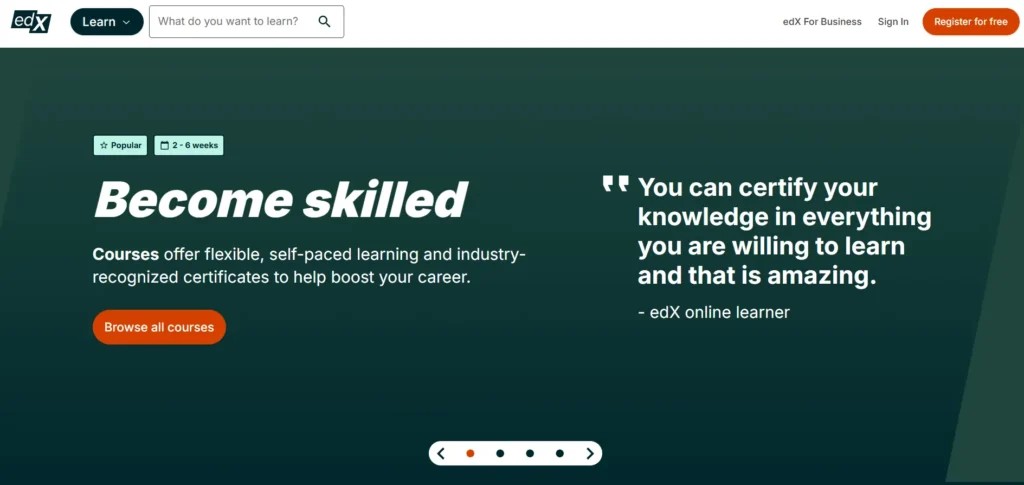
edX started in 2012 as a joint project between Harvard and MIT, created as a nonprofit to bring high-quality education online. Over time, it has grown a lot. Today, edX is part of 2U, an education technology company, though that change has raised questions in the community.
According to edX itself, it now serves 86 million+ learners, offers 4,600+ programs, and partners with 260+ institutions. Its goal is to give access to university-level courses, credentials, and even full degrees to people everywhere — on their own schedule.
In short: edX aims to combine quality (top universities and subject-matter experts) with flexibility (online, self-paced, often affordable). But does it deliver? Let’s dig into its features.
Key Features of edX
Let’s look at what edX offers under the hood — what you’ll find if you use it.
1. Wide Range of Courses
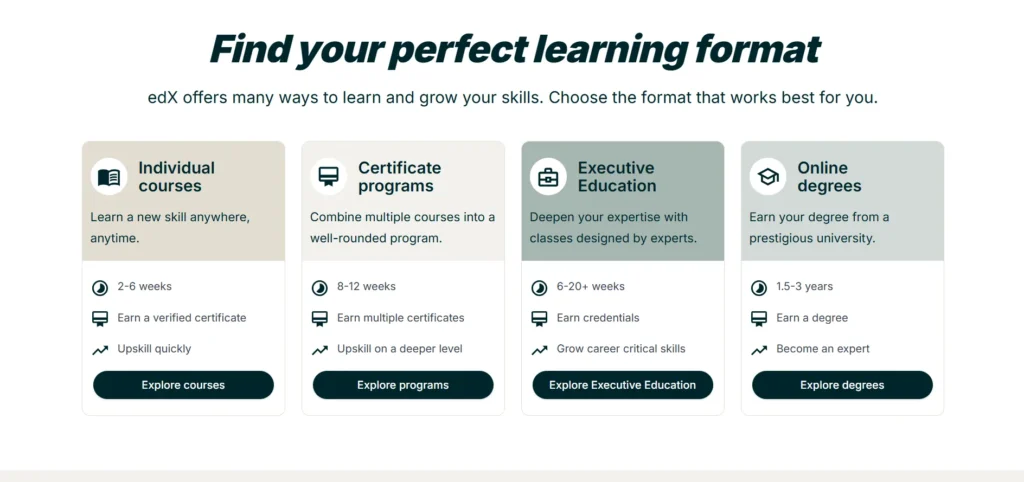
One of edX’s biggest strengths is variety. There are thousands of individual courses across domains: technology, business, health, humanities, and so on. Many of these courses are “audit-able” for free (you can access content without paying) while paying gets you assessments and a certificate.
Because there is such breadth, you can switch topics, experiment, or combine courses. You aren’t locked into just one field.
2. Flexible Learning Options
Flexibility is baked into edX’s model. Here’s how:
- Self-paced vs scheduled: Some courses let you go at your own speed, others run on a schedule with deadlines.
- Audit mode: You can often access lectures and non-graded content for free. That’s great if you just want to learn without caring about a credential.
- Deadlines and pacing tools: Even in self-paced courses, there are recommended schedules to keep you on track.
- Deadlines extension / grace periods: Many courses allow you to request more time if you fall behind (depending on the course).
This flexibility means you can fit edX courses around a job, family, or other commitments.
3. Professional Credentials
edX offers credential programs that sit between typical courses and full degrees. These include:
- Verified Certificates: After successfully completing a course (with assignments, exams), you can pay for a certificate showing your achievement.
- MicroMasters® Programs: These are advanced, graduate-level modules. They can count toward a full master’s degree at partner universities.
- MicroBachelors® Programs: Designed to be smaller, modular undergraduate-level credentials. They are relatively newer.
- Bootcamps / Professional Certificates: In some fields (e.g. data science, coding), edX offers shorter “career booster” paths.
These credentials cost money and tend to have stricter deadlines, but they carry more weight if you want recognition or to stack toward a degree.
4. Online Degree Programs
If you want a full bachelor’s or master’s degree, edX has you covered (with partner schools). These are fully online, often more affordable than on-campus options, yet come with credit recognition. The tuition can be steep (comparable to some in-person programs) but it gives you the legitimacy of a university degree.
Degrees on edX let you combine the flexibility of online learning with the structure and recognition of a university credential.
5. Top University Partnerships
One of edX’s big selling points is who offers the courses. You’ll find content from Harvard, MIT, Berkeley, Microsoft, IBM, University of Texas, and many more.
These partner institutions bring brand trust, academic rigor, and subject-matter expertise. For learners, it means you’re not just getting user-generated content — you’re getting vetted material from respected sources.
6. Global Learning Community
edX isn’t just content — it’s people. When you enroll, you often get access to discussion forums where learners and instructors interact. You can ask questions, get help, see how others solved problems, and form study groups.
There are also peer-graded assignments in many courses. That social aspect can keep you motivated and help clarify tricky topics.
That said, sometimes forums are slow, answers may be inconsistent, and instructor availability varies. That’s a limitation I’ll discuss later.
7. Mobile-Friendly Access
edX offers mobile apps (iOS and Android) that allow you to:
- Stream and download video lectures
- View transcripts and course material
- Track your progress and deadlines
- Synchronize across devices (so you can pick up where you left off)
This means you’re not tied to a desktop. You can learn on the go.
Courses Offered on edX
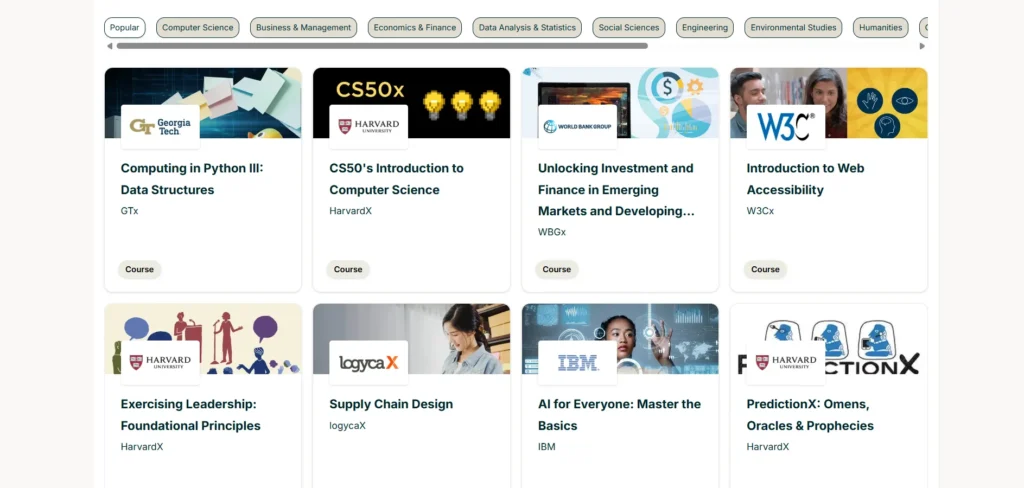
Now that we’ve seen how edX works, let’s look at what kinds of subjects you can actually study there. The breadth is solid; here are major categories you’ll find:
1. Computer Science & Technology
This is probably the most popular area. You’ll find courses in data science, artificial intelligence, programming (Python, Java, etc.), cybersecurity, software engineering, cloud computing, machine learning, and more.
If you want technical skills for today’s job market, edX is strong in this domain.
2. Business & Management
From leadership, strategy, operations, marketing, to entrepreneurship, edX offers many business courses. The MicroMasters in business analytics or supply chain, for example, can help with career shifts or enhancement.
3. Health & Medicine
You’ll find courses on public health, epidemiology, global health, healthcare management, and basics of medicine. These are especially useful for professionals wanting continuing education or non-clinical training.
4. Humanities & Social Sciences
You don’t have to stick to technical fields. edX also hosts courses in philosophy, history, ethics, psychology, sociology, political science, and more. These can be standalone interests or to complement specialized training.
5. Engineering & Architecture
More technical than general science, engineering courses include civil, mechanical, electrical, systems engineering, and architecture. If you’re already in an engineering discipline, these offerings can help you upskill in niche areas.
6. Languages
This is a smaller category at edX but still useful. You’ll find courses in language learning, linguistics, translation, and applied language skills. It’s not the primary focus, but it adds to the diversity.
Because edX offers so many choices, you can mix and match: take a technical course alongside something in the humanities, or work on a job-relevant credential while exploring a new interest.
Pricing on edX
One of the trickiest parts of any platform is cost. edX uses a layered pricing model. Here’s how it generally works:
1. Free Courses (Audit Mode)
Many courses let you audit for free, meaning you can access lecture videos, readings, and non-graded content without paying. But you won’t have graded assignments, exams, or a certificate in audit mode. This is perfect if learning is your primary goal, not certification.
2. Verified Certificates
If you want proof that you completed a course, you pay for a verified certificate. Prices for these vary widely — typically between USD 50 to USD 300 depending on the course complexity and subject.
This gives you access to graded assignments, exams, and the certificate you can show employers or on LinkedIn.
3. MicroMasters Programs
These are expensive — think multiple courses over many months. Some cost thousands of dollars. For instance, a MicroMasters in finance might list USD 3,294 as the original price across its full sequence.
Because they’re graduate-level and more extensive, they carry premium pricing. But if your goal is a credible credential that might reduce master’s requirements, they may be worth it.
4. MicroBachelors Programs
MicroBachelors are priced per credit. edX advertises a rate of approx. USD 166 per credit, making these programs more accessible than full bachelor’s degrees.
This model helps break down undergraduate-level learning into bite-sized, affordable chunks.
5. Online Degrees
Full online bachelor’s or master’s programs through edX are significantly more expensive. These are real university degrees, with tuition comparable to remote versions of on-campus programs. Expect to pay per term or credit, and often with the same rigor (and cost) as in-person degrees.
Because degree pricing varies so much depending on institution, subject, residency status, etc., you’ll need to check the specific degree program you’re interested in.
Pros and Cons of edX
Now, with all that laid out, let’s be candid about what works well and what could be better.
Pros
- High-quality content: Courses come from reputable colleges and organizations, bringing academic rigor and real subject-matter experts.
- Flexible learning: Audit mode, self-paced courses, and mobile access make it possible to learn on your schedule.
- Strong credential options: MicroMasters, MicroBachelors, verified certificates, and full degrees offer paths from casual to serious.
- Global reach: Learners from all over the world — you aren’t restricted by geography.
- Mobile app with offline features: You can download lectures and learn without always needing a live internet connection.
- Rich subject variety: Whether you want to build hard tech skills or explore humanities, edX has many options.
- Reputation & recognition: Because courses are tied to well-known institutions, credentials often carry weight with employers or universities.
Cons
- Cost can get high: While many courses are free to audit, getting certificates or enrolling in credentials and degrees can be expensive — especially for learners in countries with weaker currencies.
- Instructor / support variability: Because many courses are large-scale, you might not always get direct, fast feedback. Sometimes discussions or help are slow or superficial.
- Peer grading limitations: Peer assessments work, but quality depends on how conscientious other learners are.
- Rigid deadlines in credential courses: Even though edX supports flexibility, advanced credential programs often have stricter schedules that may be harder to relax.
Also, from user forums and Reddit:
“I took Probability and Statistics for the MITx MicroMasters … it was a bit hard to keep up with work + study. Homework often required extra research.”
“The MicroMasters is a good intro … you can enroll in each course individually rather than paying for all at once.”
These reflect the balance: high-quality but demanding.
Conclusion
edX is a strong option for anyone who wants access to real university-level learning without always being on campus. It strikes a good balance between quality and flexibility. If you’re self-motivated and clear about your goals (whether it’s upskilling, earning credentials, or pursuing a full degree), edX can be valuable.
It’s especially good if:
- You want to learn from top universities on your own time
- You are okay auditing vs paying
- You aim for credentials rather than just casual courses
- You like mixing subjects or switching paths gradually
But it may be less ideal if:
- You need intense, instant support or one-on-one mentoring
- You expect everything to be free (certificates and full programs cost)
- You’re worried about changes in ownership, costs, or platform stability
If you decide to try edX, start with a free audit course, see how the pacing and support feel. Then you can move up to paying for a certificate or a Micro credential.
FAQs
Is edX free?
Yes — many courses can be audited for free (no certificate).
Are certificates credible?
They carry weight — especially from recognized institutions — but not as much as full degrees.
How long do courses take?
Anywhere from a few weeks to several months, depending on the course or credential.
Can edX credentials count toward a real degree?
In many cases, yes — especially MicroMasters with partner schools.
Is the mobile app good?
Yes — it supports streaming, offline access, and syncing across devices.