
Learning online is no longer just watching dry lectures. Platforms are competing not only on content, but also on experience, access, and inspiration. MasterClass is one of those platforms that leans heavily into the idea of “learn from the best” — literally. The question is: does it manage to deliver both inspiration and real learning value? In this review, I dig into how MasterClass works, what stands out (and what falls short), its course catalog, pricing, pros and cons, and ultimately whether I think it’s a smart investment.
Overview of MasterClass
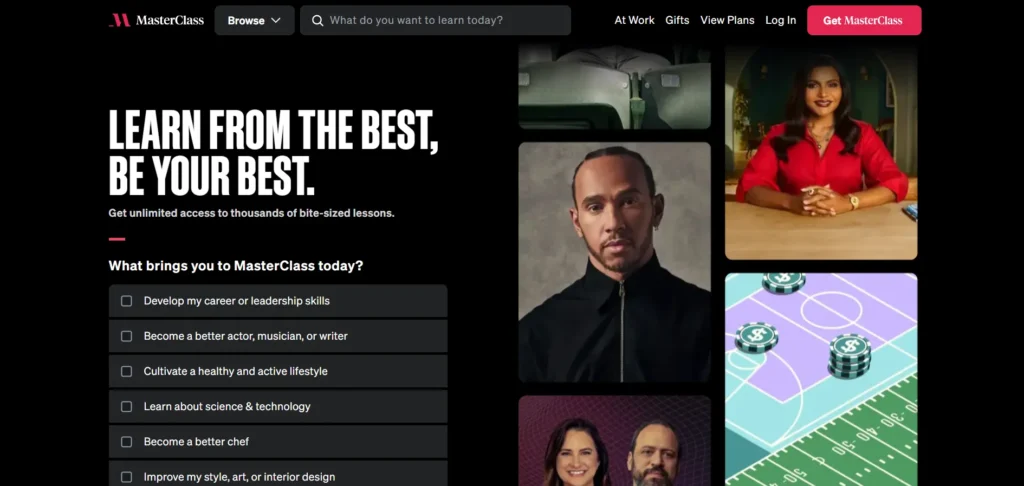
At its core, MasterClass is an online education platform that gives you access to video classes taught by well-known figures in their fields: authors, chefs, filmmakers, athletes, business leaders, musicians, and more. Instead of generic instructors, the emphasis is on stars — people with deep experience and public reputation.
The appeal is strong: how often do you get to see a famous filmmaker or a celebrated chef walk you through their thinking, process, successes and failures? MasterClass sells not just content, but proximity — a chance to see how people you admire operate.
But being flashy and star-studded is not enough. The true test is whether the classes translate into learning you can use. In this review, I parse that balance. I want you to know what to expect going in: where MasterClass shines, where it struggles, and for whom it makes sense.
Features of MasterClass
Let’s talk about the architecture of MasterClass — the features, the experience, what you get (and what you don’t). These are the building blocks that define whether the platform is more than just a pretty studio.
1. World-Class Instructors
This is the heart of the appeal. Many MasterClass teachers are names you’ll recognize — they come with authority, prestige, and a sense of gravitas. The idea is: you’re not learning from an anonymous instructor, but from a leading figure in your field of interest.
That lends itself not just to technique, but to perspective, mindset, and storytelling. You often hear about how they approached challenges, how they think about their craft, and lessons from real failures.
However, that also has a flip side. A great practitioner is not always a great teacher. In some cases, the celebrity may not deeply break down fundamentals or adapt explanations to beginners. In a few course reviews, people comment that they expected technical depth and instead got high-level narrative. Some instructors lean more toward sharing life lessons and big ideas than drilling you into step-by-step mastery.
Thus, the instructor star power is an attractive draw, but it does not guarantee depth.
2. High-Quality Production Value
One of the most consistent things people praise about MasterClass is how beautiful the classes are. The videos feel cinematic. They use multiple camera angles, thoughtful lighting, crisp audio, polished editing — sometimes sequences feel more like mini documentaries than lectures. Reviewers often contrast MasterClass with typical online course videos and say it’s in a different league for visual appeal. (It’s often described as feeling like “Netflix meets education.”) (From multiple reviews)
That production elegance makes the experience enjoyable, helps you stay engaged, and gives a sense of gravitas to the material. Watching a class is seldom tedious or visually boring.
The downside: production polish cannot fully substitute for teaching clarity or structured pedagogy. Sometimes the visuals attract, but the content does not dig deep enough for skill-building.
3. Self-Paced Learning
MasterClass is entirely asynchronous. There are no scheduled live sessions (in most courses), no fixed class times. You open a lesson when you want, pause, rewind, replay, and fit it into your schedule.
That flexibility is a core strength. It allows learners to engage when they have time—morning, late night, weekends—without worrying about shipping to a schedule.
The tradeoff: without structured deadlines or accountability, many learners stall or drop off. If you’re the type who needs external pressure to stay consistent, you’ll have to build your own structure.
4. Access to All Courses (Subscription Model)
One of MasterClass’s design decisions is to use an “all-access” model. Instead of paying per class, you pay for a subscription and then can access the entire library of courses. New courses are added periodically, and those come into your access as well.
That model has big appeal if you plan to explore broadly. You can jump between cooking, writing, filmmaking, business — and get value across multiple interests. Many users see that as a strong advantage: you’re not locked into one topic.
But there’s a catch: if you only take one or two classes, the subscription cost feels heavy. You end up “paying for stuff you don’t use.” Also, some features (like downloads or multi-device use) are gated behind higher subscription tiers, which feels like upselling.
5. Downloadable Workbooks
Each course typically comes with a workbook or PDF supplement. These include outlines, summaries, prompts, reading suggestions, and exercises or reflections.
These workbooks help convert passive watching into active thinking: you can take notes, pause to reflect, try exercises, and revisit key ideas. Many users find them helpful anchors for retention.
However, workbooks are not always deeply interactive or personalized. They don’t replace guided feedback or critique. Sometimes their exercises are more reflective than hands-on.
6. Multi-Device Accessibility
MasterClass supports use across multiple devices: desktop, mobile app, tablets, and smart TVs. You can switch between devices depending on context — smartphone on commute, laptop at desk, TV at home.
In higher subscription tiers, you also get offline download capability, which lets you download lessons to watch without Internet access (helpful for travel or unstable connections). Some lower tiers may restrict downloads.
That flexibility is now standard expectation in online learning, and MasterClass generally meets it well.
7. Exclusive Content & Structured Programs
To enhance engagement, MasterClass offers more than “watch these videos.” They have Sessions — structured programs where lessons are drip-released, assignments are given, and you follow along a guided timeline. The goal is to mimic the pacing of a course and give learners some structure.
However, these are not universal to all courses. Many classes remain in the “watch-at-will” format. Also, interactive community features (forums, peer review, live Q&A) have diminished in many cases. MasterClass has reduced or removed some forums, which means you lose peer interaction and direct instructor feedback in many classes (a common complaint).
Some older classes had “office hours” features or Q&A, but in many newer classes that interaction is absent or minimal.
Courses Offered
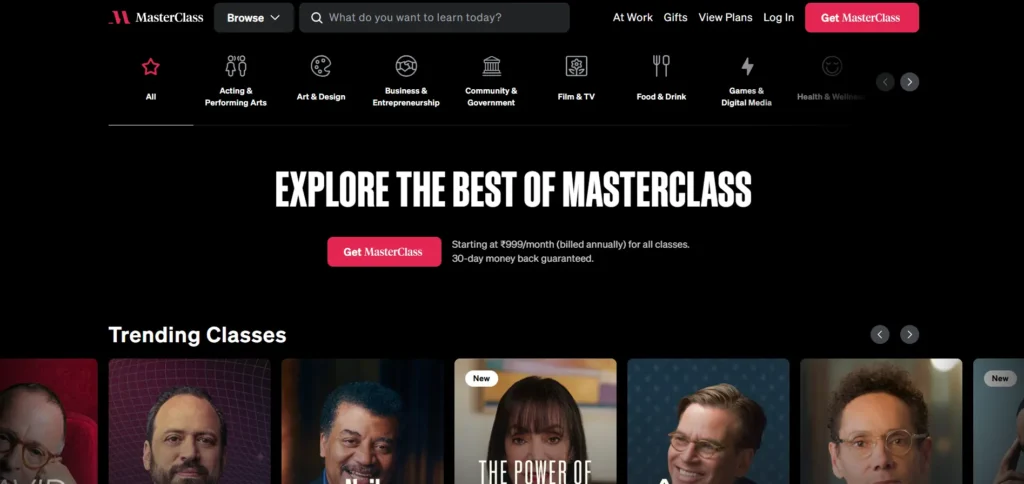
One of MasterClass’s selling points is how wide its catalog is. Below is a look at major subject categories, what they typically include, and where depth or gaps may arise.
1. Arts & Entertainment
MasterClass is strong here. You’ll find courses on storytelling, filmmaking, directing, scriptwriting, acting, photography, and more. These courses often include behind-the-scenes access, process discussions, analyzing scenes, creative decisions, and examples.
Because these are creative fields, showing technique and process visually works well. Often you’ll see how a filmmaker frames a shot, how a writer approaches structure, or how a photographer thinks about light.
These tend to be among the platform’s most polished and inspiring classes.
2. Business
Under business, you get content on leadership, entrepreneurship, innovation, branding, and strategy. Some instructors are known business figures or CEOs. The classes may mix storytelling and principles, anchored in the instructor’s experiences.
That said, these classes often remain conceptual. If you expect heavy spreadsheets, data modeling, or step-by-step strategy execution, you may be disappointed. The emphasis is more on mindset, high-level frameworks, lessons from leadership journeys, rather than nuts-and-bolts practical tools.
3. Music
MasterClass offers classes from accomplished musicians, singers, and producers. You’ll see creative insight, behind-the-scenes decision making, and some technical aspects (songwriting, producing, arranging). Again, classes tend to be more about creative process than exhaustive technique.
These are appealing when you want to see how a top musician thinks, but for someone seeking deep mastery (say, advanced audio engineering), additional resources will likely be needed.
4. Design & Style
This category includes classes on interior design, fashion, architecture, styling, and visual aesthetics. Instructors often take you through their ideation process, their workflows, sketches, visuals, and decisions in their work. Because it’s visual, MasterClass can shine in demonstrating style, visual experiments, and aesthetic thinking.
However, ultra-technical detail (e.g. color theory to extreme depth, software tools, detailed UI/UX design) may be less covered.
5. Sports & Wellness
Courses here include training mindset, fitness routines, performance habits, wellness strategies, mental approach, and sometimes diet or health discussion. Athletes and coaches share stories, rituals, mental frameworks, and guidance.
These courses are enriching — you hear how elite people approach training, habits, resilience. But they are not substitutes for a tailored fitness plan or direct coaching. You still need to practice and validate results yourself.
6. Cooking
Cooking is one of the standout areas. Seeing knife skills, technique, texture transitions, plating, ingredient combinations — all of that benefits from visual demonstration. Cooking classes often combine recipe walkthroughs, technique explanations, flavor philosophy, plating and presentation, and instructor commentary on decision making in real kitchens.
Because cuisine is so visual, MasterClass tends to deliver well here. But even then, if you expect rigorous step-by-step mastery (like precision baking), supplementary technical classes may help.
Gaps & Omissions
While the catalog is broad, certain fields are less well served. For example, deep technical subjects like advanced computer science, engineering, niche trades, or certification courses are not MasterClass’s strength. If your goal is a credential or a job-relevant technical syllabus (say data science, advanced software engineering, or deep academic domains), other platforms may suit better.
Pricing
| Plan | Monthly Rate (billed annually) | Annual Cost | Devices (simultaneous) | Offline Downloads | Key Details |
|---|---|---|---|---|---|
| Standard / Individual | $10 per month | $120 per year | 1 device | No | Access to all courses, but limited to one device at a time. |
| Plus / Duo | $15 per month | $180 per year | 2 devices | Yes | Includes offline viewing and allows use on two devices simultaneously. |
| Premium / Family | $20 per month | $240 per year | Up to 6 devices | Yes | Designed for families or groups; supports multiple devices and offline downloads. |
Additional Notes:
- All plans are billed annually, meaning you pay for the full year upfront rather than month to month.
- Each plan provides full access to the entire course library — the main differences are device limits and offline availability.
- MasterClass offers a 30-day satisfaction guarantee — you can request a refund within that period if you’re not satisfied.
- Pricing may vary slightly depending on your region or currency.
Pros and Cons of MasterClass
Here’s a clear breakdown of what MasterClass does well and where it repeatedly draws criticism.
✅ Pros of MasterClass
- World-Class Instructors – You learn directly from well-known experts, artists, entrepreneurs, and performers who have achieved top-tier success in their fields.
- Exceptional Production Quality – The videos are beautifully shot, with professional lighting, editing, and direction. Lessons feel more like a documentary than a classroom.
- Wide Range of Topics – One subscription gives you access to hundreds of courses spanning writing, cooking, business, design, music, sports, and more.
- Self-Paced Learning – You can watch anytime, pause, rewind, and progress at your own speed without deadlines or live sessions.
- Engaging Workbooks and Extras – Many classes include downloadable workbooks with summaries, assignments, and reading recommendations to reinforce key ideas.
- Multi-Device and Offline Access – You can stream on your phone, tablet, computer, or TV, and higher-tier plans let you download classes for offline viewing.
- Motivational and Inspiring – Even when not highly technical, the stories and insights from experts often leave learners inspired and more confident about pursuing their craft.
⚠️ Cons of MasterClass
- Some Features Locked Behind Higher Plans – Offline downloads or multi-device streaming often require upgrading to a pricier tier.
- Limited Depth in Many Courses – Some classes focus more on broad philosophy and inspiration than on detailed, step-by-step instruction.
- No Direct Feedback or Interaction – You can’t ask questions, get critiques, or receive personalized coaching from instructors.
- Annual Billing Only – Subscriptions are charged yearly, so you pay upfront even if you’re unsure how much you’ll use it.
Conclusion
So, is MasterClass worth it? My verdict: yes, but under the right expectations and usage.
If you treat it as a supplement — not a full substitute for hands-on practice, mentoring, or structured training — it can be a powerful resource. It’s terrific when you want to absorb mindset, creative approaches, lessons from top figures, and insight into how experts solve problems. It’s also useful to wander across fields: cooking, writing, design, leadership — having access to all that diversity is rare.
But if your goal is rigorous, technical mastery in specialized fields, or you need feedback and accreditation, MasterClass likely won’t be enough by itself. You’ll need complementary tools, courses, or mentors.
If I were advising you as a friend: try the subscription for 30 days (making sure you use that window), pick two or three courses across distinct fields that genuinely interest you, engage deeply, and evaluate what you get. If you come away inspired, with new ideas, and motivated to act, then it becomes worth the cost. If you find you quit early or you don’t use it, then maybe it wasn’t the right fit.
To sum up:
- Use it for inspiration, frameworks, creative perspective, and seeing how elites think.
- Don’t expect it to replace hands-on training, mentorship, or peer critique.
- If you’ll explore multiple fields in a year, the subscription model can deliver strong value.
- If you want depth in a narrow technical field, pair it with more technical platforms.
MasterClass is unlikely to be perfect for everyone — but for the curious, creative, and motivated learner, it can be a worthy tool in your learning toolbox.
FAQs
Is MasterClass good for beginners?
It can be inspiring and accessible for beginners, though you may need other resources for deep technical guidance.
Can I cancel anytime and get a refund?
You can request a refund within 30 days, but because billing is annual, make sure you act in that window.
Do you get certificates?
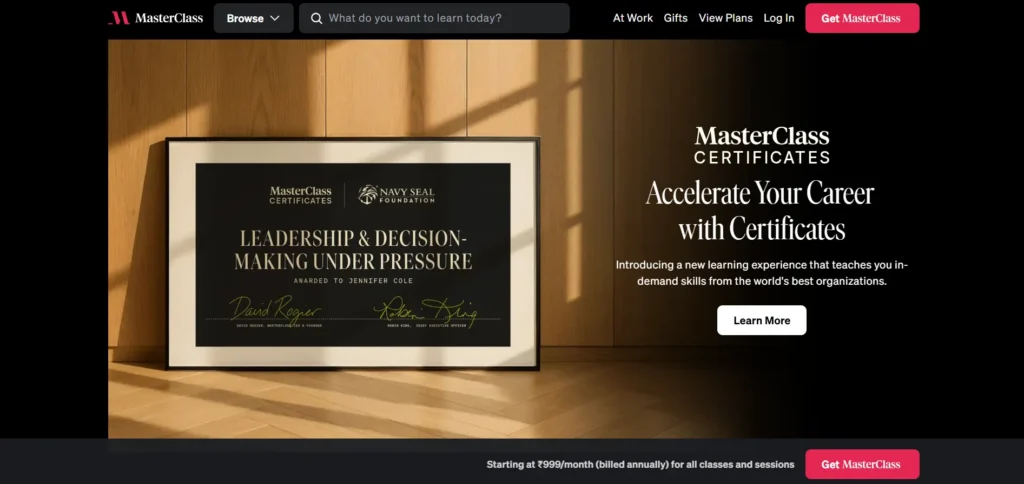
No, MasterClass typically does not provide formal or accredited certificates.
Can you download videos for offline viewing?
Yes, but offline downloads are usually restricted to higher subscription tiers.
Does one subscription support multiple users/devices?
Only in higher subscription tiers; the base plan often limits you to one device.