
Digital marketing is no longer optional for businesses, and many people see it as a promising career path. But the question is: how do you learn it well in a way that holds up in 2025? The Udacity Digital Marketing Nanodegree (DMND) positions itself as that path. In this review, I dig into what it really offers, where it shines, where it falls short, and whether you should consider enrolling.
What is the Udacity Digital Marketing Nanodegree?
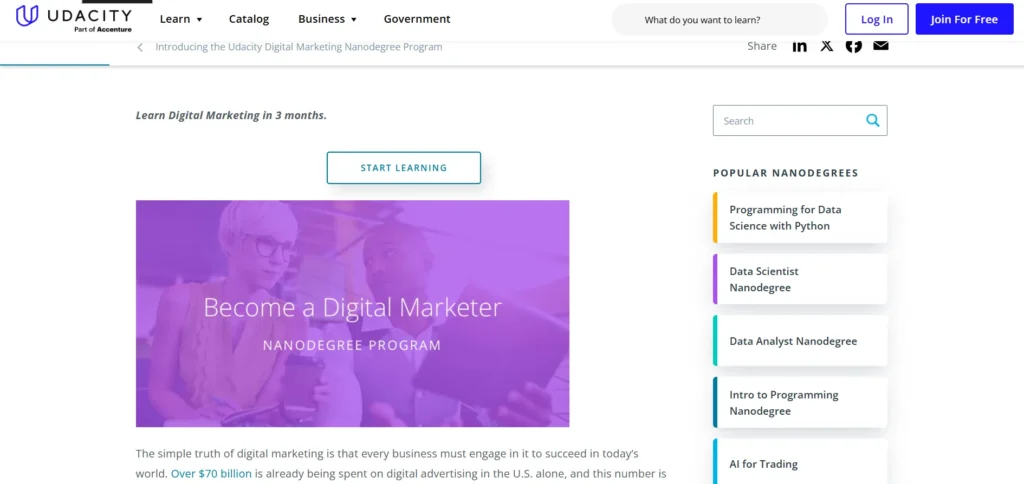
The Udacity Digital Marketing Nanodegree is a structured online program designed to teach you the essential skills across the digital marketing landscape—SEO, paid advertising, content strategy, analytics, social media, email, and more. Unlike a one-off course that covers one topic, this program aims for a holistic, career-ready experience.
Here’s what makes it more than just a “course”:
- It is built around projects, not just lectures. Each module ends with a deliverable you complete.
- You receive feedback from reviewers and, to some extent, mentor support.
- The curriculum is periodically updated to reflect changes in tools, trends, and platforms.
- The program includes career services, such as resume reviews, LinkedIn help, and interview prep.
- You earn a Nanodegree “certificate” upon completing all modules.
Udacity states that the program covers fundamentals like SEO, PPC, social media, email, content, as well as campaign measurement and analytics. The syllabus also includes module frameworks such as “Get Ready to Market,” “Digital Marketing Framework,” and hands-on campaign tasks. (From Udacity’s course description.)
In broad strokes, this is a program meant to take someone with little background and help them become capable of planning, executing, analyzing, and optimizing digital marketing tactics.
Course Structure and Curriculum
Now let’s break down the curriculum in detail. Because Udacity organizes content in its own way, the seven categories you asked for (Introduction, SEO, SEM, etc.) don’t always map perfectly to separate modules. But I’ll align what the course actually offers to those:
1. Introduction to Digital Marketing
This is part of the “foundation” or “get ready” section. Here you learn:
- What digital marketing means today
- The major channels and how they interconnect
- Customer journeys, buyer personas, value propositions
- The marketing funnel
- How to think strategically rather than tactically
A typical early project is: consult for a mock brand (like Magnolia Coffee), identify a marketing objective, define a persona, and sketch a marketing plan for that brand. This helps you ground the rest of the work.
2. SEO (Search Engine Optimization)
SEO is one of the core pillars. The curriculum covers:
- How search engines work
- Keyword research and selection
- On-page SEO: page structure, tags, URL structure, navigation
- Off-page SEO: link building basics
- Technical aspects and audits
- Running an SEO audit as a project
One explicit project is called “Conduct an SEO Audit,” where you analyze a real site (or mock) and recommend fixes. From Udacity’s module listing, there is a lesson on SEO audit and performance.
However, many student reviewers say this portion is useful and solid but not deeply advanced. It gives you tools to diagnose and improve, but not always the most cutting-edge or very advanced technical strategies.
3. SEM (Search Engine Marketing)
This is the paid search side. You learn:
- How Google Ads and search ads work
- Campaign structure (brands, ad groups, keywords)
- Bidding, quality score, ad rank
- Metrics such as CTR, conversion, cost per acquisition
- How to optimize campaigns
- A project: “Evaluate a Google Ads Campaign” where you analyze metrics and suggest improvements
Many students say the SEM module is among the more concrete and immediately applicable parts, because paid search gives quick feedback loops.
4. Social Media Marketing
Udacity gives strong coverage to social media as a channel. This includes:
- Organic vs paid social
- Platform differences (especially Facebook / Meta)
- Ad creation, targeting, budgeting, metrics
- Content strategy and adaptation per platform
- Running a “social media strategy” project
One project is to create both an organic and paid social strategy for a brand (e.g. PYUR Skincare in the course). The module includes a full flow from planning to execution and measurement.
Because social media is rapidly changing, this part is updated frequently. Some students appreciate that the course reflects recent ad formats and trends.
5. Email Marketing
This topic is less a full standalone chunk and more integrated into campaigns. You learn:
- Email fundamentals: structure, deliverability
- Segmentation and targeting
- Drip campaigns / sequences
- Email metrics: opens, clicks, bounce, deliverability
- How email ties into the rest of your funnel and channels
This is a practical inclusion because email remains a potent, cost-effective tool in multi-channel marketing.
6. Content Strategy
Content strategy isn’t a module in isolation but is woven through the program. You’ll do:
- Content planning and mapping to funnel stages
- Editorial calendars
- Aligning content with SEO, social, and ads
- Measuring content performance
- Messaging, tone, and audience fit
Every campaign you design has content at its heart, so this is a cross-cutting element rather than a stand-alone.
7. Digital Advertising
Ad strategy is both in SEM and social modules, but there is additional coverage of:
- Display ads
- Remarketing / retargeting
- Cross-channel ad budgeting
- Attribution and tradeoffs between channels
Because the program spans multiple channels, digital advertising is handled in context—how you coordinate ads across search, social, and display.
Plus, there is a data & analytics or “Marketing Data & Technology” area that ties all of it together: measuring, interpreting, testing, and optimizing. That’s the connective tissue that helps you make strategic decisions.
Each module leads to a project. In total, you might have around 7 projects (one per module or per major section). These are not quizzes—they are output you can show in a portfolio.
Third-party reviews often emphasize those projects as among the strongest features. For example, MLTut’s review describes that “every project is based on real-world problems and reviewed by marketing professionals.”
Key Features of the Udacity Digital Marketing Nanodegree
What sets this apart from just free content, or cheaper courses? Here are the key distinguishing features.
1. Project-Based Learning
You don’t just watch videos and take quizzes—you build real deliverables. SEO audit reports, PPC campaign analyses, social media strategies, email flows—these become your portfolio. Many learners say those projects are the most valuable takeaway. (MLTut review)
2. Feedback from Experts
When you submit work, reviewers critique it. That helps you improve. Some students say feedback is detailed, helping you refine your thinking and execution. (MLTut)
The flip side: some learners report occasional delays in feedback or less consistency in reviewer quality. (MLTut review)
3. Flexibility
You decide when to study. Though Udacity suggests a pace (usually 10 hours/week for three months), you can speed up or stretch it depending on your schedule. Bitdegree calls it “flexible timetables.”
This flexibility is a major advantage if you have other commitments. But it also demands self-discipline; procrastination is a real risk.
4. Career Support
Udacity offers services such as:
- Resume reviews
- LinkedIn profile optimization
- Interview prep
- Job search guidance
It doesn’t guarantee a job, but it can help you present what you’ve built in a marketable way. Several reviews note that this support helps people transition into roles or freelance work.
5. Community & Network
You get access to peer forums, Slack or discussion channels, mentor sessions, and possibly exposure to hiring partners. Being part of a learning community helps you stay motivated, exchange ideas, and sometimes find connections or referrals.
6. Up-to-Date Content
One of the complaints in many online courses is that content becomes stale. Udacity frequently updates modules, especially in social media and ad channels, to reflect new features and trends. (Student reviews often praise this aspect.)
7. Credibility & Signaling
Because Udacity uses “Nanodegree” branding, partnerships with companies, and a well-known platform, having that credential can signal seriousness more than obscure courses. That said, it’s not academic accreditation.
Pricing Plans
Let’s talk money. The cost is often the dealmaker or dealbreaker.
- According to Bitdegree, the three-month version is priced at €927.
- Alternatively, a monthly pay-as-you-go option of €359 per month is listed.
- Prosperity for America states Udacity offers $249/month, or a four-month discounted bundle (~$212/month), or a one-time payment of $949.
- MLTut notes that the program is expensive relative to many MOOCs, but claims you may find occasional discounts.
So roughly, expect something in the $700–$1,000+ band depending on region, currency, and discount. It’s not trivial.
Udacity sometimes gives personalized discounts or scholarships, which may reduce cost if you apply at the right time.
Because it’s premium priced, the question becomes: will you recoup it in value, skills, confidence, or job prospects?
Pros of the Udacity Digital Marketing Nanodegree
Having seen how the program works and what people say about it, here are the main strengths.
1. Comprehensive Curriculum
You get exposure to nearly everything a modern digital marketer should know—SEO, paid search, social, email, content, metrics, retargeting. Few single programs span so much ground while retaining cohesion. Several reviews praise this “360-degree” approach. (At Boyd Consulting)
2. Hands-On Projects
The fact that every major module ends in a project is hugely valuable. You end not just with knowledge, but with artifacts you can show. Many learners cite the portfolio work as the thing they most value.
3. Industry-Relevant Skills
Because the course is built to reflect actual tools and real ad platforms, what you learn tends to transfer better to job responsibilities rather than just theory.
4. Support and Feedback
Having someone review your work, answer technical questions, or guide strategy gives you a safety net. That is a level of guidance many cheaper or free courses do not offer.
5. Flexibility
You can balance your schedule. If you need to pause or stretch, you usually can. That makes it viable for working professionals or those studying in parallel.
6. Credible Signaling
A certificate, plus the brand name Udacity and the fact that the curriculum is market-oriented, gives you a stronger story to tell in interviews or proposals than random free courses.
7. Motivation & Accountability
Because you pay, commit, and have deadlines or projects, you’re more likely to follow through than with free content. The structure helps prevent infinite procrastination.
8. Continuous Updates
Especially for a fast-changing domain like marketing, keeping content current is vital. Students often highlight that the social media and ad modules reflect recent changes.
Cons of the Udacity Digital Marketing Nanodegree
No program is perfect. Here are the drawbacks you should weigh carefully.
1. High Cost
The biggest critique. Many learners say they could find much of the same content via lower-cost or free alternatives (Udemy, blogs, YouTube) and invest the saved money elsewhere. On Reddit, one commenter said: “You can probably find the same info for $10 on Udemy.”
Because you’re paying a premium, expectations are higher—and if the returns don’t match, dissatisfaction is more acute.
2. No Formal Accreditation
Your Nanodegree certificate is not the same as a university credential. For sectors or employers that look for accredited programs, this may not carry weight. Bitdegree and others mention this in their critiques.
3. Depth vs Breadth Tradeoff
Because the program covers many channels, individual modules sometimes feel introductory. Advanced SEO, deep analytics, programmatic advertising, or technical marketing might not receive as much depth. One Medium reviewer who already had marketing experience said: “If you currently work in the digital marketing space, don’t expect so much out of it.”
4. Response Delays
Some students report that mentor or reviewer feedback can sometimes lag, which slows momentum. That can be frustrating, especially if you’re stuck on a module and waiting to move forward.
5. Requires Self Discipline
Because it’s flexible and partly self-paced, you need discipline to maintain momentum. Many learners stall or stretch the timeline and lose clarity or energy.
Reviews and Student Feedback
To make this more grounded, here are real voices from learners and reviewers.
From Reddit, one student writes:
“I’m enjoying it, learning a lot. … you can probably find the same info for $10 on Udemy.”
“Currently enrolled … Great information, you apply the modules with … real Facebook and Google ad campaign (for Udacity).”
These highlight both the value and the cost sensitivity. (Reddit thread)
From Medium:
“The Digital Marketing Nanodegree is a thorough overview of digital marketing ecosystem. If you currently work in the digital marketing space, don’t expect so much out of it.”
“After my program, I am more confident in myself and my skills … I’m applying some of those skills to my blog.”
This suggests nonlinear return: confidence and baseline skills matter as much as domain depth.
From MLTut:
- They rate content, projects, and instructor quality highly, but note that project feedback can sometimes be delayed and support could be more personalized.
- They assert the real-world orientation of the projects is a standout.
From At Boyd Consulting:
- They call the program a “good introductory course” with 360-degree coverage and hands-on campaign experience.
- They say it helps people decide which digital marketing path to specialize in (SEO, content, analytics, etc.).
From Prosperity for America:
- They note that the course feels less like boring lectures and more like dynamic engagement.
- They report active application: students say they could implement strategies on their own sites or small projects.
From Course Report reviews of Udacity students (more generally):
- Many praise the structure, community, project experience, and how the platform helps them freelance or scale skills.
- Some mention the stress or pressure of meeting project deadlines, or juggling time.
From Oscar Leo (a reviewer who’s completed multiple Nanodegrees):
- He says Udacity is a “cost-effective way to learn a new skill,” but warns that “you won’t become good by only doing a Nanodegree—you need deliberate practice beyond the course.”
- He notes that some instructors are stronger than others depending on style and delivery.
These voices converge on common themes: strong project orientation, helpful structure, weakness in depth in some modules, and the ever-present tension between cost and perceived value.
Is the Udacity Digital Marketing Nanodegree Worth It?
This is the crux: should you enroll? Let me break it down by scenario.
When it’s likely worth it
- You’re starting fresh or changing careers. If you lack experience and want structured guidance, this program gives a foundation and a guided path.
- You need a portfolio. The project work gives you real artifacts you can show.
- You thrive in guided environments. If having deadlines, feedback, mentors, and structure helps you learn, this is a solid choice.
- You can invest the time and money responsibly. If you see this as an investment, not just a course, you will get more out of it.
- You use the career services actively. Taking advantage of resume help, networking, and strategy pushes you closer to earning value from your investment.
When it may not be worth it
- You already have solid digital marketing experience. Much of the content will feel familiar and not deep enough.
- You have tight budget constraints. The cost is high; cheaper or free alternatives combined smartly might suffice for your goals.
- You need formal academic accreditation. The Nanodegree isn’t a recognized academic credential.
- You prefer full depth in one niche. If you want to go deep into technical SEO, advanced analytics, or programmatic advertising, you might outgrow this course.
- You lack discipline or support. If you struggle to self-motivate, the flexible format may allow procrastination.
If I were advising someone: go for it if you’re serious, committed, and want a structured push into digital marketing. Don’t expect this to be the final step; the real growth comes from applying, experimenting, failing, and iterating in real markets.
In many reviews, the verdict is that the Nanodegree is a good start, not a definitive masterclass. For example, MLTut says it “stands out due to its practical approach, industry relevance, and up-to-date content,” but notes limitations in depth.
One balanced view is that you should treat this as a strong scaffolding—you build upon it with real campaigns, niche learning, experimentation, and continuous updates.
Final Thoughts
In 2025, online education has grown more crowded, more competitive, and more scrutinized. The Udacity Digital Marketing Nanodegree holds up well as one of the stronger packaged offers for aspiring digital marketers. It gives you structure, feedback, projects, and a roadmap through channels that matter today.
Its strengths lie in its holistic curriculum, actionable project orientation, support mechanisms, and credibility. Its drawbacks lie in cost, depth limitations, reliance on learner discipline, and the fact that the certificate is not academically accredited.
FAQs
How long does the Udacity Digital Marketing Nanodegree take?
It usually takes about three months if you study around ten hours a week, but it’s self-paced so you can go faster or slower.
Do I need marketing experience before starting?
No. It’s beginner-friendly and starts from the basics.
Will I get a certificate?
Yes. You receive a Nanodegree certificate after completing all the projects, though it’s not an accredited degree.
How much does it cost?
Expect to pay roughly between $700 and $1,000, depending on your plan and region.
Is it worth it?
Yes, if you’re a beginner who wants structured, hands-on training and can afford the cost. It’s less useful if you’re already experienced in digital marketing.