
You might already have a sense: DataCamp is one of the go-to platforms for learning data and analytics. But “go-to” doesn’t necessarily mean “best for you.” In 2025, the landscape is more crowded, expectations are higher, and competition is fierce. So here’s what you should know: who DataCamp works for, where it falls short, how it stacks up against alternatives, and whether it’s still worth your time and money.
Overview of DataCamp
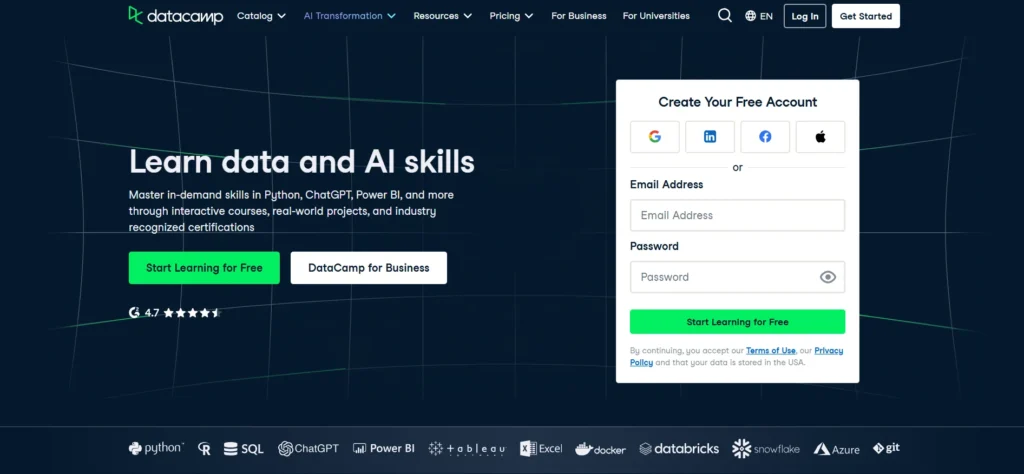
DataCamp is an online education platform focused exclusively on data skills: programming (Python, R, SQL), data analysis, visualization, machine learning, data engineering, business intelligence, and related tools. What sets it apart (or at least what it claims to) is hands-on, interactive learning—you get to write code directly in your browser as you learn.
Over the years, DataCamp has layered features: curated “tracks” to guide your path, real data projects, assessments, and more recently AI assistance to help you when you get stuck. As of late 2024 and early 2025, many reviews point to those new updates (especially AI help) as a meaningful step forward.
In short: DataCamp wants to offer a full stack of data learning in one place, with a strong emphasis on doing, not just watching.
Key Features of DataCamp
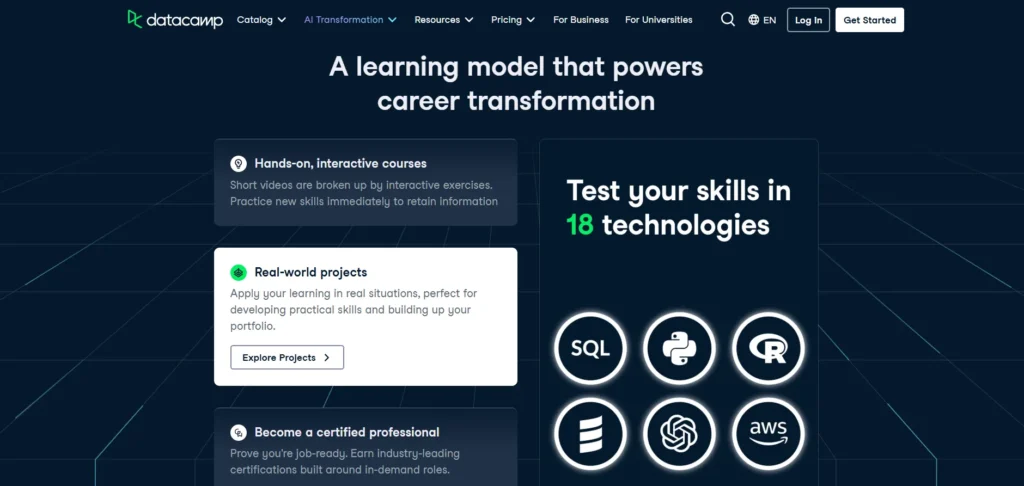
Let’s break down the features you’ll actually use or run into. These are the battlegrounds where the strengths and flaws show.
1. Interactive Learning
This is the heart of DataCamp’s approach. Instead of long video lectures followed by separate assignments, it intersperses short teaching bits with coding exercises right there in the browser. You see a concept, then you try it. You get instant feedback.
Pros:
- Low setup barrier. You don’t need to configure Python environments, install packages, etc., just to start learning.
- Encourages “learn by doing,” which many users find more engaging and effective.
- Mistakes are part of the process: you can try, fail, see what went wrong, and correct.
Cons:
- Feedback is sometimes superficial (“right” or “wrong”) and may not explain why you erred.
- For more complex problems, hints might not be enough. Some users feel stuck without deeper guidance.
- Because it’s browser-based, sometimes performance lags (especially if your network is slow) or the interface feels cramped compared to a full IDE.
Many users on platforms like G2 praise the ease of hands-on lessons, especially for beginners. But several also ask for more end-to-end projects and better error feedback.
2. Personalized Learning Paths
If you just stare at a course catalog, you’ll get overwhelmed. That’s why DataCamp offers Skill Tracks and Career Tracks. These group courses and modules into sequenced paths. For example, a Data Analyst career track might first take you through Python basics, then data manipulation, then visualization, then machine learning, etc.
These structured paths help:
- Guide you in a logical progression.
- Prevent gaps—so you don’t skip a foundational skill.
- Let you measure progress.
But:
- Some tracks may feel rigid if you already know parts of them (you may redo content you already mastered).
- Advanced or niche topics sometimes get short shrift in these tracks.
- Tracks might not align 100% with your specific focus or domain.
Overall, many reviewers say the paths are one of DataCamp’s strongest features, especially for beginners who don’t know where to start.
3. Real-World Projects
Theory is necessary but not sufficient. DataCamp includes projects—mini or mid sized tasks where you work with datasets (often real ones) to answer questions, build models, or produce visualizations.
These help you:
- Apply what you’ve learned in context.
- Build portfolio pieces you can show.
- Integrate multiple skills (programming, analysis, visualization) in one flow.
However, recurring critiques are:
- Many projects remain relatively contained or guided; they may not replicate messy real data problems.
- There aren’t always as many domain-diverse, large scale projects as learners would like.
- Some projects feel a bit “canned” and don’t fully reflect how data problems differ in real settings.
But overall, the presence of projects is a big plus—just don’t expect every project to be a career-level case study.
4. Courses by Experts
DataCamp’s content creators are often data practitioners or domain specialists. This tends to produce examples and explanations that are current, clear, and applicable. Users regularly praise the teaching clarity, good examples, and structured lessons.
On the flip side:
- Because content is prebuilt, interaction is minimal. You typically don’t have live access to an instructor or in-depth office hours.
- If you ask a tricky question or hit a corner case in your own solution, you may not get help beyond standard hints or community forums.
In other words: good lectures, solid content, but limited personalization or mentorship.
5. AI-Powered Assistance
One of the big shifts in 2025 is DataCamp’s push into AI help—especially within their coding / workspace environment. This means you can ask for hints, debugging suggestions, or code ideas when stuck.
This is promising because:
- It gives near-instant help rather than waiting for forums.
- It can reduce frustration in tricky segments.
- It brings the platform closer to giving you something like a tutor.
But caveats:
- Don’t rely on it totally — you’ll still need to think through logic yourself.
- The AI help is only as good as its training and context; sometimes suggestions may be generic.
- It may encourage dependency rather than problem solving.
Still, many recent reviews mention AI assistance as a differentiator now.
6. Flexible Learning Options
- Lessons are broken into bite-sized segments. This helps when you have limited time.
- You can learn at your own pace—no hard deadlines (unless you set them for yourself).
- Mobile compatibility exists, so you can consume theory or simpler exercises on the go (though complex coding often works better on desktop).
- Progress tracking, streaks, reminders, gamification features help with motivation.
Downsides:
- Offline learning is limited. To do interactive exercises you need internet.
- Some users feel the mobile interface is constrained or lacks full functionality.
- If your daily schedule is unpredictable, even bite-sized lessons can feel hard to keep consistent.
Courses Offered on DataCamp
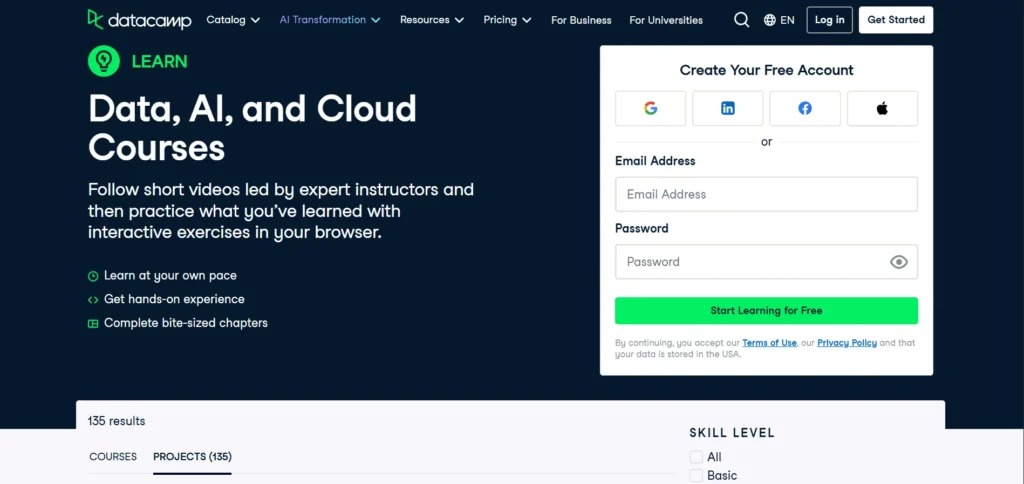
Here’s a look at what topics you’ll find. As of 2025, the range is solid within the data realm, though not infinite.
1. Programming Languages
Foundations matter, so DataCamp offers:
- Python: Covers basics and moves into data science usage (NumPy, Pandas, scikit-learn). The “Introduction to Python” course is built for absolute beginners—no prior experience required.
- R: For statistics, analysis, and domain users who favor R’s ecosystem.
- SQL: Essential for querying, joining, filtering database tables, window functions, etc. Many data roles require SQL fluency.
The presence of these three pillars (Python, R, SQL) is essential; DataCamp handles them well.
2. Data Analysis & Visualization
Once you have your data, you need to clean, explore, visualize, and interpret it. You’ll find courses in:
- Data cleaning and wrangling
- Exploratory data analysis
- Visualization using libraries such as Matplotlib, Seaborn, ggplot, plotly
- Dashboarding and reporting (sometimes integrating with BI tools)
These courses help you form the habit of inspecting and interpreting data.
3. Machine Learning & AI
On top of fundamentals, DataCamp includes modules in:
- Predictive modeling (linear regression, classification)
- Clustering, dimensionality reduction
- Neural networks, simple deep learning
- Model evaluation, overfitting, cross-validation
- Some newer AI integrations
If you pursue a career track in “Data Scientist,” expect these to be part of your roadmap.
4. Business Intelligence & Data Tools
Beyond code, many roles touch BI tools and visualization platforms. DataCamp offers:
- Tutorials on Tableau, Power BI (or at least integration touchpoints)
- Courses in dashboard design
- Reporting and business analytics modules
However, in comparison to specialized BI platforms, coverage is a bit more introductory in many of these areas.
5. Data Engineering
Data engineering is a bit more advanced—things like pipelines, ETL, big data systems. DataCamp offers:
- Courses on data pipelines
- Handling and processing data flows
- Integrating with databases, managing data at scale.
But many reviews say this domain is less mature on DataCamp compared to analytics or machine learning. For deep specialization in data engineering, you may need supplementary learning elsewhere.
Pricing Plans
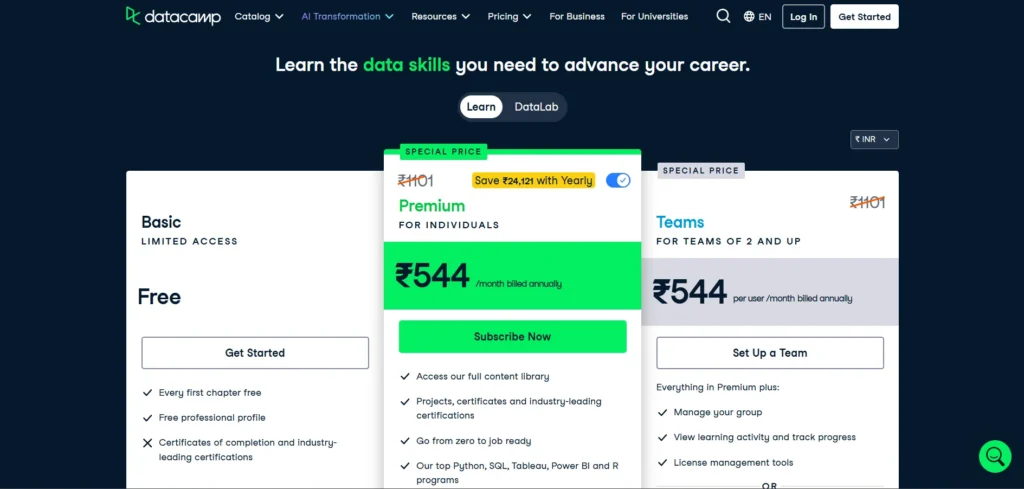
Cost matters. How much do you pay, and what do you get? As of mid 2025, DataCamp’s pricing is more transparent than many, but still has trade-offs.
Free Plan (Basic)
- You can access the first chapter of every course for free.
- Get a “professional profile” and limited content.
- You won’t unlock full tracks, projects, or certification.
- Good for sampling or experimenting—seeing if the style fits you.
The free plan is limited, but useful if you want to try before buying.
Premium (Individual)
This is where most serious learners will land.
- The “Premium” plan gives unlimited access to the full content library, including all courses, tracks, projects, certification, etc.
- Pricing is quoted as $14 per month when billed annually. If you pay month-by-month, the cost is higher.
- Many reviews mention discounts or special pricing offers periodically.
- Premium includes “industry-leading certifications” and access to DataCamp’s full toolset.
Reviews say that the Premium plan is the real value point—if you intend to go deep.
Teams Plan
For groups or small teams:
- Same content access as Premium.
- Tools for managing and monitoring learners (progress tracking, license management).
- Cost is per user and usually tied to annual billing.
- Useful for companies wanting to upskill staff.
Enterprise Plan
For larger organizations with advanced needs:
- Custom pricing, custom content, single sign-on, LMS integrations, enterprise features.
- Ability to create company-specific learning paths and reports.
- Best if you’re a training manager or HR function handling many learners.
Pros of Using DataCamp
Here’s what users consistently mention as strengths:
Interactive Learning Experience: The ability to practice coding directly in the browser is a game-changer. This hands-on approach accelerates learning and helps reinforce theoretical concepts.
Comprehensive Course Offerings: With courses spanning a wide range of topics, DataCamp provides a complete toolkit for aspiring data scientists, analysts, and engineers.
Industry-Relevant Content: DataCamp’s courses are constantly updated to reflect the latest tools, technologies, and best practices in the data science industry.
Real-World Projects: The platform’s focus on real-world projects makes it easy to build a portfolio that can impress potential employers.
Structured Learning Paths: The Career Tracks and Skill Tracks provide clear and organized paths for learners to follow, making it easier to progress and stay motivated.
Flexible Learning Options: DataCamp’s mobile app, ability to learn at your own pace, and access from any device make it perfect for busy professionals.
Cons of Using DataCamp
It’s not perfect. Here’s where users frequently raise red flags:
Limited Free Content: Although DataCamp offers a free plan, access is very limited, with only the first chapter of each course available. Most of the valuable content is locked behind the paid plan.
Not Ideal for Advanced Learners: While DataCamp is excellent for beginners and intermediate learners, more advanced practitioners may find the courses to be too basic. The platform lacks the depth needed for highly experienced data scientists.
No Formal Accreditation: While the certificates you earn from DataCamp are useful for showcasing your skills to employers, they are not officially accredited by any educational institution, which may limit their value in certain professional settings.
Conclusion: Is DataCamp Worth It?
Here’s my take:
Yes—DataCamp remains a strong candidate in 2025, especially for beginners or those transitioning into data roles. But it’s not a magic wand, and it’s not enough by itself.
If you:
- Are new to data science or analytics
- Prefer a hands-on, guided approach
- Want to build coding confidence
- Don’t want to worry about setup or environments
- Can commit to consistent study for several months
then DataCamp gives excellent value. The new AI assistance helps smooth out some pain points. You’ll likely get more than your money’s worth in terms of skill acquisition and confidence.
However, if you:
- Are already advanced in certain areas
- Want deep specialization (especially in data engineering or advanced ML)
- Need accredited certifications
- Rely heavily on offline study
- Want a mentor, live coaching, or deep feedback loops
then DataCamp may not suffice on its own. You’ll want to supplement with books, open source projects, specialized courses, or bootcamps.
To maximize value:
- Use DataCamp to build core skills and structure.
- Work on external projects (with real world datasets) to push your limits.
- Use portfolios and public code (GitHub) to show competence.
- Use forums, communities, and maybe pair programming to get deeper feedback.
In short: DataCamp is a fantastic backbone for your data learning journey. But it’s not the entire journey.
FAQs
What is DataCamp?
DataCamp is an online learning platform that offers interactive courses and projects focused on data science, machine learning, and analytics.
Is DataCamp suitable for beginners?
Yes, DataCamp is beginner-friendly. It starts with the basics and gradually helps you build solid programming and data skills through guided lessons.
Can I learn for free on DataCamp?
You can access a limited selection of lessons for free, but full access to courses, projects, and certifications requires a paid plan.
Does DataCamp offer certifications?
Yes, DataCamp issues certificates for completed courses and learning tracks, which you can showcase on your resume or LinkedIn profile.
How does DataCamp’s interactive learning work?
DataCamp lets you write and run code directly in your browser, giving you instant feedback as you practice what you learn.