
Switching careers can feel intimidating, especially when you’re trying to break into fast-moving industries like data science, programming, or artificial intelligence. Traditional degrees often take years and cost a fortune, while many online courses barely scratch the surface.
That’s where Udacity comes in. It promises a middle ground — short, intensive programs called Nanodegrees designed in partnership with major tech companies like Google, AWS, and IBM. The idea is simple: teach practical, job-ready skills that help you transition into tech-driven roles without spending years in school.
Udacity’s focus isn’t on academic theory. Instead, it emphasizes real projects, hands-on experience, and mentorship from industry professionals. You’re not just watching videos; you’re building apps, writing data pipelines, and deploying AI models. The platform also includes career support such as resume reviews and interview preparation to help learners turn their new skills into real opportunities.
But while Udacity’s reputation for quality is strong, it’s not without drawbacks. It’s more expensive than most other online learning platforms, and its catalog is focused mainly on tech-centric fields. Some users praise the structure and career outcomes, while others criticize the cost and occasional lack of mentor engagement.
In this review, we’ll take a close, honest look at Udacity — exploring its features, popular courses, pricing, pros and cons, and whether it’s truly worth your investment. By the end, you’ll have a clear idea of whether Udacity is the right platform to help you pivot into a new career.
What is Udacity?
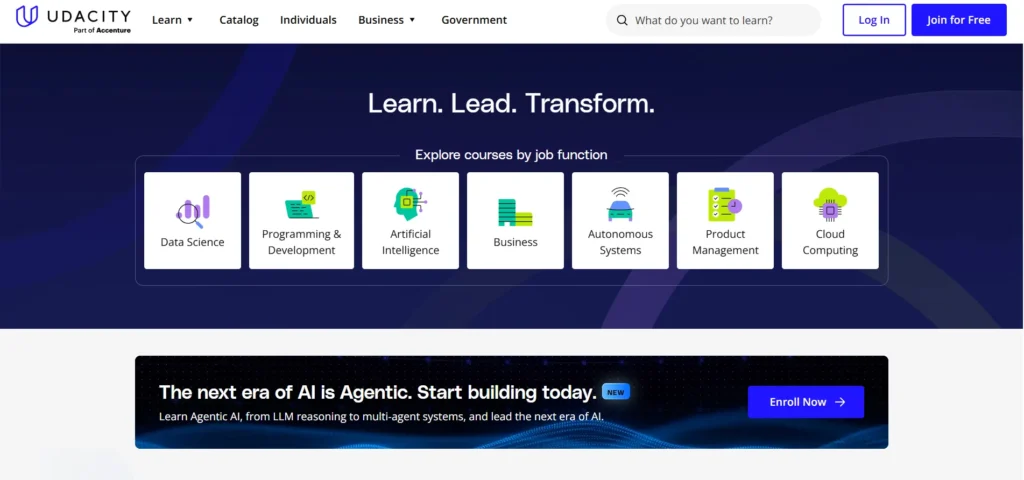
Udacity is an online education platform specializing in technology-driven skills—think data science, AI, cloud, software engineering, etc. Unlike platforms that simply aggregate university courses, Udacity designs many of its Nanodegree programs in-house or in collaboration with industry partners. Its aim is to help learners build job-ready skills, not simply deliver theory.
One important caveat: Udacity is not an accredited institution. The certificates you get won’t count as academic credits toward a degree. Its value is in the skills, portfolio, and potential job boost, rather than the credential.
Over time, Udacity moved from a per-Nanodegree payment model toward a subscription one—so you pay to access a broad catalog of content rather than buying one program at a time.
Key Features of Udacity
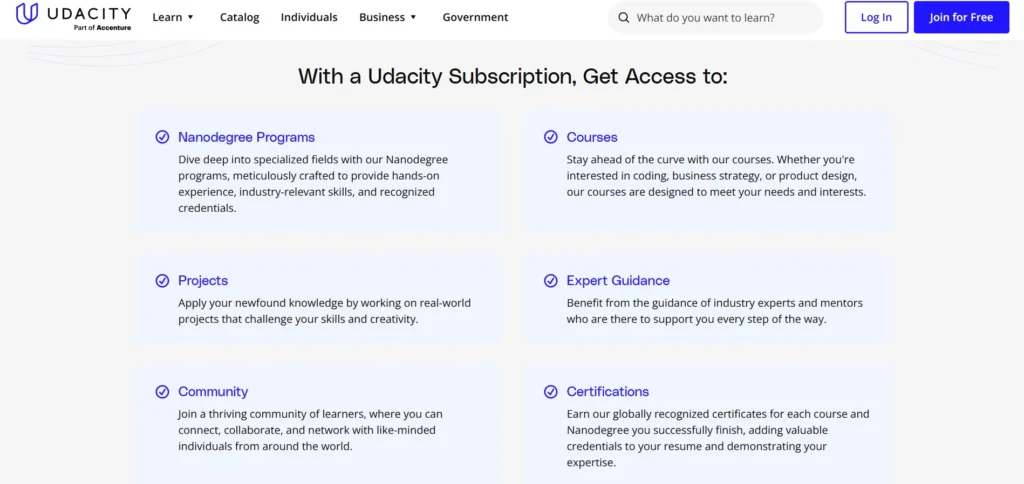
Here’s a breakdown of what makes Udacity stand out, and where it falls short.
1. Nanodegrees
Nanodegrees are Udacity’s core offering. They’re structured, multi-month programs aimed at a specific professional topic (data engineering, full stack dev, etc.). Each Nanodegree includes multiple courses, quizzes, and hands-on projects. The idea is: complete it, build a portfolio, and gain a credential you can show to potential employers.
These programs tend to be more intensive than casual online courses. Because of their structured project work, they give you something tangible beyond just theory.
2. Project-Based Learning
This is where Udacity’s strengths shine. Rather than just watching videos or doing multiple choice quizzes, you regularly work on real projects (often resembling real job tasks). Those projects are reviewed by human evaluators or mentors, who give feedback and allow you to revise.
This practical approach helps you build a portfolio—something to show future hiring managers. Many learners say this differentiates Udacity from platforms that are more lecture-driven.
3. Mentorship and Support
Udacity provides mentors and technical support to help you when you’re stuck. Many reviews note that mentors can help you debug code, understand difficult concepts, or give direction when you’re lost.
However, some learners report inconsistency—delays in mentor responses or occasional unavailability. If you rely heavily on frequent, timely mentoring, your experience might vary.
4. Career Services
Alongside skills, Udacity gives various career support services for many Nanodegree students: resume reviews, interview prep, LinkedIn optimization, GitHub feedback, and job search help. Their “Talent Network” also lets employers discover graduates.
That said, these services tend to be most effective in regions where tech hiring is strong (e.g. U.S., Western Europe). If you’re in a location with fewer tech jobs, the “getting hired” side might be less powerful.
5. Flexible Learning Options
Udacity’s programs are largely self-paced. You can speed up or slow down depending on your schedule. This flexibility is crucial for learners who work or have other commitments.
They also maintain a catalog of standalone courses (some free) so you don’t always have to commit to a full Nanodegree to explore a topic.
6. Industry-Relevant Curriculum
Because Udacity collaborates with companies and frequent industry experts, the curriculum tends to stay tuned to what’s in demand—cloud, ML, AI, data pipelines, etc. They update their materials from time to time.
Still, tech evolves fast. There are occasional complaints that parts of a course lag behind current industry practices—especially tools or frameworks that shift quickly.
Udacity Courses and Nanodegrees Offered
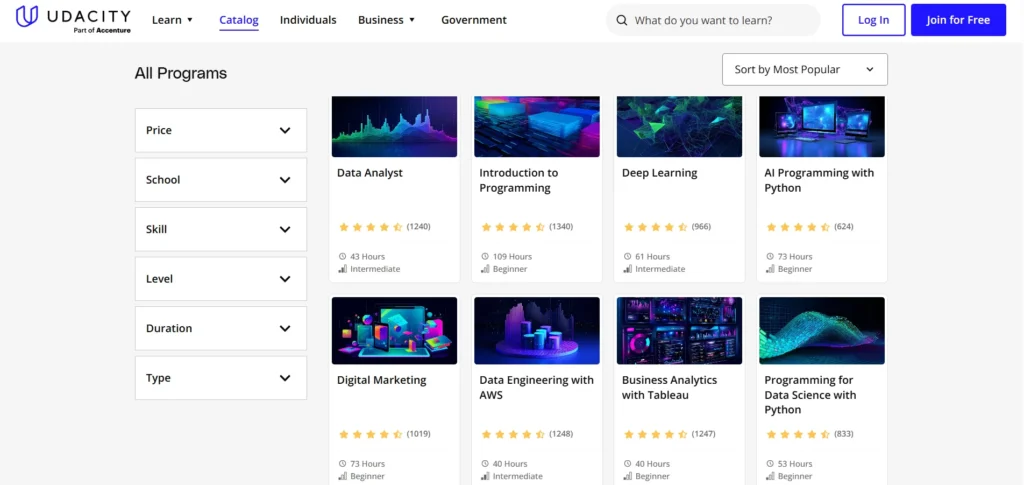
Here’s a quick overview of the major fields Udacity supports, and what learners tend to say.
1. Data Science
This is a flagship area. Their Data Scientist or Data Analyst Nanodegrees cover Python, statistics, machine learning, data pipelines, visualization, and so on. Many learners praise the mix of theory + hands-on work.
2. Artificial Intelligence (AI)
Udacity offers deep learning, reinforcement learning, and broader AI programs. Reviews point out that the visual explanations and projects are strong, but the learning curve can be steep—especially if you don’t already have programming or math basics.
3. Programming
They offer general programming tracks (Python, web dev, full-stack) and domain-specific ones (e.g. mobile). These tend to be foundational tracks you might take before diving into specialized domains.
4. Cloud Computing
Given the shift to the cloud, Udacity has strong offerings in cloud infrastructure, DevOps, deployment, etc. Many learners say that these parts of the curriculum are especially relevant and helpful for getting jobs.
5. Digital Marketing
This is a smaller but meaningful domain. Their marketing and growth nanodegree tracks mix data, analytics, and strategy. For learners coming from non-tech backgrounds, these can serve as a bridge.
6. Business
They also offer tracks like product management, business analytics, and leadership. These tend to combine technical and strategic elements. The business tracks may not go as deep as an MBA, but they can add relevant skills for tech roles.
Udacity Pricing Structure
Let’s talk money—this is a crucial part of the decision.
Payment Options
As of September 2023, Udacity moved to a subscription model. You can either pay monthly or choose a 4-month bundle.
- The standard monthly subscription is $249/month.
- If you pay upfront for 4 months, you pay $846 total, which gives you about 15% discount over paying month by month.
- With your subscription, you get access to their entire catalog: all Nanodegrees and courses, as long as your subscription is active.
- There’s also often a 2-day refund window (depending on region).
- In the past, Udacity had a model where you paid per Nanodegree; now the subscription gives you freedom to hop across topics.
Because many Nanodegrees are designed to take about 4 months, the bundled option is what Udacity expects most people to take.
That said, some specialized Nanodegrees (e.g. Deep Learning, AI) may have different internal pricing or bundles for their individual track.
Pros of Udacity
Here are the major advantages that many learners (and reviewers) point out:
1. High-Quality, Industry-Relevant Content
Udacity designs many courses themselves with input from tech companies. The materials tend to be polished, up to date, and relevant to actual job requirements.
2. Project-Based Learning
You don’t just passively consume content—you build things. These projects let you show concrete work in a portfolio.
3. Career Support
The career services (resume, GitHub review, mock interviews) add real value beyond just learning.
4. Flexible Learning
You can adapt the pace based on your life—which is essential if you’re switching careers while working or managing other commitments.
5. Expert Mentorship
Having real mentors to help you move past blocks is a big plus—though results vary, when it works well, it can boost progress.
Cons of Udacity
No product is perfect. Here are the drawbacks and limitations to be aware of:
1. High Cost
At $249 per month, Udacity is one of the pricier online learning options. Many learners globally find it expensive relative to income or alternatives.
2. Limited Course Options Outside of Tech
Udacity is strong in tech, data, AI, cloud, etc. If you want liberal arts, humanities, or general non-technical fields, it’s thinner.
3. No Academic Credit
Since it’s not accredited, your Nanodegree won’t count in a formal college or university pathway.
4. Inconsistent Mentor / Review Delays
Some users report that feedback on projects can be delayed—sometimes 24 hours or more, even up to several days. That can slow momentum.
5. Scholarship / Discount Limitations
While there are occasional discounts and some scholarship programs, they’re not always available or accessible to everyone globally.
6. Dependent on Local Job Market
Even with excellent skills, getting a job depends heavily on your local ecosystem. In regions with fewer tech opportunities, the payoff may be lower.
Conclusion: Is Udacity Worth It?
Udacity is best suited for someone serious about switching into a technical or data role, with willingness to invest time, money, and focus. If you can keep a steady pace and leverage the mentorship, project feedback, and career services well, the payoff can be real.
But if the cost is a big burden, or if you’re unsure whether tech is for you, Udacity may feel risky. In those cases, starting small (with free or cheaper courses elsewhere) might make sense until you’re convinced.
In short: Udacity is not perfect, but it’s one of the stronger options in the premium online tech education space. If it fits your budget and your career goals, it’s worth serious consideration.
FAQs
Can I pay monthly or must I commit long term?
You can pay monthly, or choose a 4-month bundled payment.
Do Udacity certificates carry academic credit?
No, they are not accredited and don’t count as formal academic credit.
Is mentorship guaranteed in every course?
Yes, but quality and responsiveness may vary.
Can I access multiple Nanodegrees under one subscription?
Yes, a subscription gives access to the whole catalog while active.
Does completing a Nanodegree guarantee a job?
No guarantee, but career support is included to improve chances.