
Higher education can be expensive, but what if you could access college-level courses for free? That’s the idea behind Saylor Academy, a nonprofit platform that has been offering open online courses since 2008. Its mission is simple: make education accessible to anyone, anywhere, at no cost.
Saylor Academy provides over a hundred self-paced courses across subjects like business, computer science, humanities, and mathematics. You can learn entirely online, earn free certificates, and even gain college credit for a small fee if you pass a proctored exam. It’s designed for motivated learners who prefer flexibility over rigid schedules.
However, while the promise of “free college courses” sounds almost too good to be true, it comes with trade-offs. Course quality varies, credit transfer isn’t always guaranteed, and the experience can feel very independent.
In this review, we’ll explore what Saylor Academy really offers—its features, course quality, pricing, pros and cons, and how to make the most of it. By the end, you’ll know whether Saylor is a smart option for you or just another online learning experiment that sounds better on paper than in practice.
What is Saylor Academy?
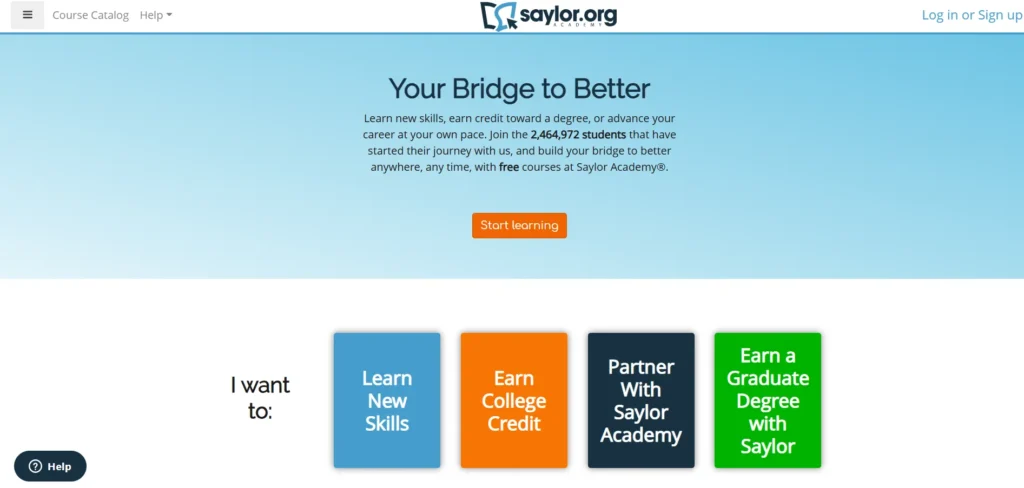
Saylor Academy is a nonprofit initiative with the mission to offer free and open online education. It was founded in 1999 (by Michael J. Saylor) and launched the “Free Education Initiative” around 2008. It is based in Washington, D.C. and operates under nonprofit status.
According to public records, Saylor is not a degree-granting institution itself—but rather it hosts courses and offers certain routes so that learners can claim credit or certificates.
Its model: you study the course materials freely, take quizzes and exams, and for some courses you can take a proctored exam for a small fee to earn credit (if the course is eligible). Otherwise, you can receive a certificate of completion.
The catalog is wide: in 2025, Saylor lists about 113 courses across subjects—humanities, business, math, computer science, social sciences, and more. Many courses come with free certificates. (According to ClassCentral)
So, to sum up: Saylor is like an open online course library with a twist: for certain courses, you can convert your work into credit (if your target institution accepts it).
Key Features of Saylor Academy
Here are the standout features—good and bad—that you should know before jumping in.
1. Free Courses
One of Saylor’s strongest draws is that the majority of its course content is free. You can access readings, lecture materials, quizzes, practice exams without paying. The only cost comes when you opt for a proctored exam (for credit) in eligible courses.
This “free access” model lowers the barrier for learners worldwide.
2. Self-Paced Learning
Everything in Saylor is self paced. There are no fixed deadlines, no class schedule, no weekly live sessions you must attend (for most courses). You decide when you want to study, skip ahead, or pause.
This flexibility is great if you have a job, family, or other responsibilities. But it also requires strong discipline: many learners find it easy to procrastinate or lose motivation.
3. Wide Variety of Courses
Though Saylor isn’t massive like some MOOC platforms, its course catalog is broad enough to cover many university general education areas and core subjects. You’ll find business, humanities, computer science, math, social sciences, language, even professional skills.
For example, you might find courses like CS107: C++ Programming, BUS301: Human Resource Management, ENGL210: Technical Writing, ESL001: Elementary English as a Second Language, and many more. (ClassCentral lists these.)
Having this variety means you can potentially piece together several courses relevant to a degree or interest.
4. College Credit Opportunities
This is one of the more ambitious features. For some courses, Saylor offers a “direct credit” path: you take a proctored exam (small fee) and, if you pass, Saylor gives you a transcript which you can submit to colleges that accept it.
Some courses are recommended for credit by bodies like the American Council on Education (ACE) or the National College Credit Recommendation Service (NCCRS). However, not all courses are credit-eligible.
One key caveat: even if you earn credit, many colleges may choose not to accept it. Transfer policies vary widely.
So credit is possible, but not guaranteed.
5. Open Access and Global Reach
You don’t always need to register to browse the course content. Some materials are openly viewable. Only when you want certificates or proctored exams do you need an account.
Because it’s online and open, Saylor can serve learners from all over the world, as long as you have internet access.
This openness is part of its mission: democratizing education.
6. Certificates of Completion
After you finish all required modules and pass the non-proctored final exam, Saylor issues a certificate of completion for free. It’s not the same as credit, but it signals that you earned the course.
Many users treat these as proof of self-study or skill development to include in resumes or portfolios.
7. Interactive Content
It’s not purely text. Courses usually include readings, quizzes, practice exams, sometimes video material or external resources. This mix helps with variety and retention.
Some courses even offer live review sessions (for example ESL) on YouTube. (There’s a Saylor video for ESL001 review.)
However, the depth and quality of this interactive content can vary from course to course.
Courses Offered by Saylor Academy
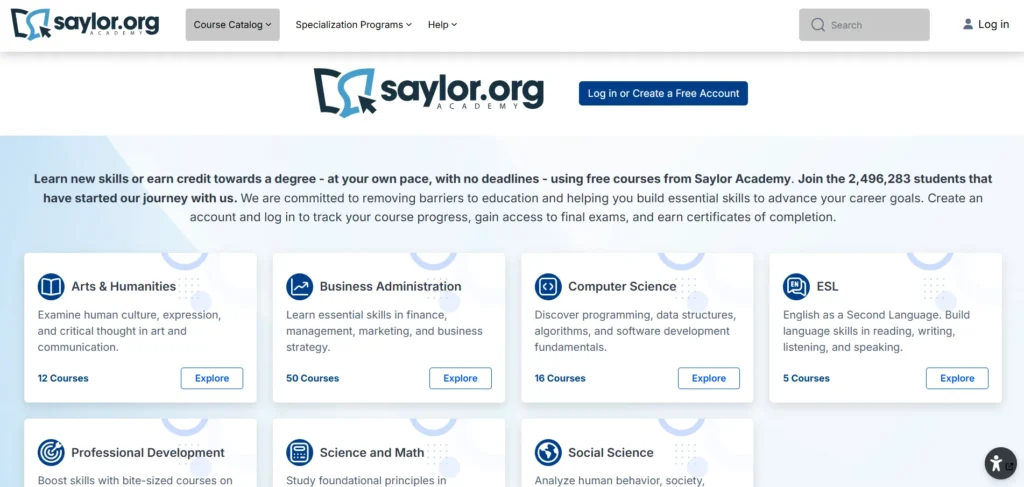
To get a clearer sense, here’s a more concrete breakdown of what you’ll find.
1. Arts & Humanities
If your interests lean toward writing, literature, philosophy, or communications, Saylor offers courses like:
- English Composition
- Technical Writing
- Literature / Humanities electives
- Communication and rhetoric
These tend to be more text intensive and often involve essays, reading, analyzing arguments.
2. Business Administration
This is one of Saylor’s stronger areas. You’ll see:
- Management
- Organizational Behavior
- Business Law
- Marketing
- Human Resource Management
These courses tend to be modular and involve case studies, business theory, scenarios.
3. Computer Science
If you want to get technical, you can find:
- Introductory programming (e.g. C++)
- Data structures
- Software engineering
- Algorithms
These demand logical thinking, coding practice, and often mixing reading with problem solving.
4. Science & Mathematics
You’ll find courses like:
- Algebra
- Calculus
- Statistics
- (Some) natural sciences
Math courses tend to be more challenging in a self-paced structure. Users mention that certain math modules in Saylor suffer from misalignment or errors in questions.
5. Social Sciences
These include:
- Psychology
- Sociology
- Economics
- Political Science
They tend to lean more toward readings, theory, essays, discussion. More stable content, less prone to technical errors (based on user reviews).
Because Saylor has around 113 courses, you can mix and match from these domains to build a viable study path.
Pricing at Saylor Academy
One of the biggest appeals of Saylor is that much of what it offers is free. But here’s a breakdown of costs and what you should expect.
1. All Courses Are Free
Access to readings, resources, quizzes, and non-proctored exams is generally free. You won’t pay anything for most of the learning content.
2. Proctored Exams
If you choose the credit route for eligible courses, you’ll pay a small fee—currently USD 5—for the proctored exam. This is unusually low compared to many other platforms.
You typically get up to three attempts. However, there may be waiting periods between attempts.
This is the only real “monetary cost” for many learners who aim for credit.
3. Certificates of Completion
Non-credit certificates are free once you pass the non-proctored final exam. So you don’t have to pay for certification, unless you want the credit transcript route.
So in practice: most learners can get full value without paying a dime, unless they pursue credit.
Pros and Cons of Saylor Academy
Here’s my balanced take. The strengths are real, but so are the weaknesses.
Pros
- Very low cost or free: Access without paying is a big plus.
- Flexibility: Self-paced learning means you can study on your schedule.
- Decent subject variety: Enough choice to cover general education or electives.
- Credit potential: The ability to convert work into credit is a powerful feature when it works.
- Open access: Free certificates and open resources show transparency and mission.
- Global reach: Learners anywhere can use it.
- Proof of effort: Certificates can support resumes or portfolios.
These advantages make Saylor very appealing to independent learners, self-starters, or those testing the waters before committing to formal education.
Cons
- Inconsistent course quality: Some courses use outdated materials, have broken links, or lack polish since they rely on open educational resources from different sources.
- Limited credit transfer: Not all colleges accept Saylor’s ACE or NCCRS credits, so you need to confirm transferability before investing time in credit-eligible courses.
- Minimal instructor support: There are no active instructors or discussion forums, which can make it harder to get help when you’re stuck.
- Heavy reading load: Many courses are text-based with few interactive or multimedia elements, which can feel dry or overwhelming for some learners.
In practice, Saylor is best suited for self learners who already have some self-direction and are willing to verify credit acceptance with potential institutions.
What Users Say (Real Feedback & Critiques)
To ground this review, here are excerpts and summaries from what users online have said.
- On Trustpilot, Saylor has a 4.0/5 rating from about ten reviewers. Many praise the free certificate and the credit option (“It’s free (actually $5) for college credit!”). But some complain about site crashes, poor UI, and unstable exam experience.
- One 1-star review said: “The site constantly crashes … I finish one page, click next, it crashes in a final exam.”
- Another said: “If you don’t obtain a 70 or higher on the exam, you can retake—but they don’t show which answers were wrong. Just the final score.”
- On Reddit (r/WGU_CompSci), one user said: “I’m taking calculus from Saylor and it sucks. Some practice questions simply can’t be answered as they don’t provide all the information… some answers are wrong…”
They conceded the $5 exam is cheap, but the educational experience can be frustrating. - On DegreeInfo forums, many note that courses “can be hit or miss.” Some courses have broken links, inconsistent structure, messy transitions. One user said: “They don’t develop or host any of the course content, so some courses are disjointed, with redundant material, broken links.”
- Some critiques point out that Saylor sometimes assigns 100% weight to the final exam, making the entire course hinge on one test.
- Others mention that not all courses are currently valid for credit (some ACE or NCCRS accreditations expire or lapse).
So the user feedback mixes praise for affordability and access with serious complaints about quality, reliability, and exam design.
How to Use Saylor Effectively (Tips from Experience & Users)
Saylor Academy can be a fantastic resource if you know how to use it wisely. While its flexibility and free access are appealing, success largely depends on how you approach the platform. These steps combine practical experience and lessons shared by learners who’ve used Saylor for self-study and college credit.
Step 1: Explore and Evaluate Courses
Start by browsing Saylor’s course catalog. Read the descriptions carefully and check if the course you want is part of the Direct Credit program. Make sure the subject aligns with your goals and that the course looks current. Some courses haven’t been updated in a while, so skim through the lessons and make sure the links and materials are still working before committing your time.
Step 2: Set Clear Goals
Decide why you’re using Saylor. Are you learning for college credit, to refresh your knowledge, or to build new skills for work? Your reason will determine how seriously you need to prepare for the proctored exam or whether the free completion certificate is enough. Having a specific purpose keeps you motivated and focused.
Step 3: Make a Study Plan
Since all Saylor courses are self-paced, you’ll need to create your own structure. Set weekly goals—like completing one unit or chapter per week—and block out dedicated study time. Treat it like a real class rather than casual browsing. Most learners who succeed with Saylor treat their study hours as non-negotiable appointments.
Step 4: Take Notes and Stay Organized
Saylor courses are text-heavy, so note-taking is essential. Write short summaries of key concepts, formulas, and definitions as you go. This not only helps you retain information but also gives you a quick reference for review before your exam. Digital tools like Notion, Google Docs, or OneNote can make your study notes easy to organize and revisit.
Step 5: Use Practice Tests and Quizzes
Every Saylor course includes quizzes and a practice final. Use these to test yourself before taking the proctored exam. Pay close attention to your weak areas and revisit those sections. Many students find that repeating practice exams until they consistently pass helps them feel more confident and better prepared for the real test.
Step 6: Supplement with Outside Resources
Because some courses can be outdated or overly dense, it’s smart to cross-reference with other materials. Watch YouTube lectures, review open textbooks, or use sites like Khan Academy to clarify difficult topics. Mixing resources makes the learning process more engaging and helps fill in any gaps.
Step 7: Confirm Credit Transfer Policies
If your goal is to earn college credit, check with your college or future institution before paying for the proctored exam. Not every school accepts Saylor credits, even those recommended by ACE or NCCRS. Verifying this early saves you time and frustration later.
Step 8: Take the Exam When You’re Ready
Once you’re consistently scoring well in practice tests, schedule the proctored exam. Make sure your computer, webcam, and internet connection are reliable. Most exams require a 70% or higher score to pass, and you can usually retake them after a waiting period if needed.
Step 9: Reflect and Plan Your Next Step
After you complete a course, download your certificate or transcript and take a moment to review your progress. Think about what you learned, where you struggled, and how you can improve your next study plan. Report broken links or issues to help Saylor maintain quality.
Step 10: Stay Informed
Follow Saylor’s newsletter or social media for updates. They occasionally refresh old courses, add new ones, or expand their credit partnerships—all of which can open more doors for you.
When used thoughtfully, Saylor Academy can be more than just a free resource—it can become a stepping stone to formal education or career advancement. The key is structure, consistency, and a little extra initiative.
Final Verdict
Saylor Academy is a fascinating model in the world of open education. It has real potential—especially for motivated learners with clear goals—but it also comes with significant caveats.
If you’re someone who:
- already has some self-discipline,
- is comfortable with independent learning,
- understands the risks around credit transfer,
- and is okay with some messiness or errors in the material
—then Saylor can be a very economical way to learn college-level topics and potentially earn credit.
On the flip side, if you need structured pacing, guaranteed credit, stable systems, or a polished learning experience, you might find Saylor frustrating or risky.
In 2025, Saylor remains strongest when used as a supplemental or testbed tool. Use it to explore subjects, build skills, test your readiness, or take cheaper credits. But don’t rely on it as your sole path without careful planning and backup alternatives.
FAQs
Is Saylor accredited?
No. Saylor itself does not grant accreditation or degrees.
Are all courses eligible for college credit?
No—only certain courses have “direct credit” paths when available.
How much does the credit exam cost?
Around USD 5 per proctored exam.
Do I need to register to study?
No for most materials; registration is needed for exams and certificates.
Can I finish a course on my own time?
Yes. Everything is self paced—no mandatory deadlines.