
Online learning has evolved quickly, and Coursera remains one of the biggest names in that space. Founded by Stanford professors in 2012, the platform has grown into a global hub for education, partnering with top universities and leading companies to offer everything from short courses to full degree programs.
Millions of learners now use it to pick up new skills, earn professional certificates, or even complete accredited degrees without leaving home.
In 2025, the question isn’t whether Coursera has content—it’s whether that content is still worth your time and money. With so many free videos, paid certificates, and competing platforms like Udemy, edX, and LinkedIn Learning, Coursera must prove its value through quality, credibility, and job relevance.
This review looks closely at what Coursera offers today—its most popular courses, pricing structure, pros, cons, and real-world impact. Whether you’re trying to boost your career, learn a new subject, or simply explore something different, this guide will help you decide if Coursera is the right investment in 2025. By the end, you’ll know when it’s worth paying for—and when it’s smarter to learn for free.
What Is Coursera?
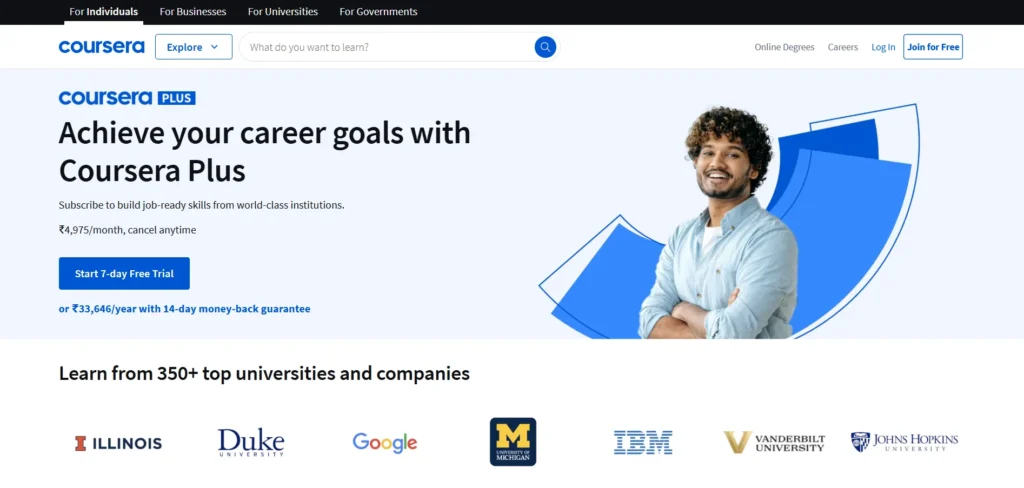
Coursera is an online learning platform that connects learners to courses, certificate programs, and full degrees, offered in collaboration with universities and companies. From its launch in 2012, Coursera has expanded far beyond MOOCs, now offering thousands of learning paths across a wide range of subjects.
You can use Coursera to:
- Take individual courses (often with video lectures, quizzes, reading, sometimes assignments)
- Enroll in multi-course pathways (specializations, professional certificates)
- Work toward accredited degrees (bachelor’s or master’s)
- Audit many courses free of charge, though paying unlocks full access and certificates
By 2025, Coursera remains one of the leading names in online higher education, especially for learners who want credentials tied to respected institutions. But whether it’s “worth it” depends on your goals, discipline, and how you use it.
Top Courses and Specializations: Summary
Here is a table summarizing the Top 10 Courses and Specializations on Coursera based on popularity, learner ratings, and industry recognition:
| Course Name | Provider | Duration | Level | Rating | Description |
|---|---|---|---|---|---|
| Google IT Support Professional Certificate | 6 months (5 hours/week) | Beginner | 4.8/5 | A comprehensive introduction to IT support, including troubleshooting, customer service, and networking. | |
| IBM Data Science Professional Certificate | IBM | 3 months (5 hours/week) | Beginner | 4.7/5 | Covers data analysis, visualization, and machine learning with Python. |
| DeepLearning.AI Machine Learning Specialization | DeepLearning.AI | 3 months (4 hours/week) | Intermediate | 4.9/5 | Learn machine learning techniques including supervised and unsupervised learning. |
| Python for Everybody Specialization | University of Michigan | 5 months (4 hours/week) | Beginner | 4.9/5 | Introduction to programming using Python and learning data structures, databases, and web scraping. |
| Google Project Management Professional Certificate | 6 months (5 hours/week) | Beginner | 4.7/5 | Learn project management fundamentals, including Agile and Scrum methodologies. | |
| Data Science Specialization | Johns Hopkins University | 11 months (7 hours/week) | Intermediate | 4.8/5 | A comprehensive deep dive into data science concepts, including R programming and machine learning. |
| Digital Marketing Specialization | University of Illinois | 8 months (6 hours/week) | Beginner | 4.7/5 | Learn digital marketing techniques covering SEO, social media, and digital analytics. |
| Google IT Automation with Python | 6 months (5 hours/week) | Intermediate | 4.8/5 | Learn Python automation skills focused on IT tasks such as configuration, troubleshooting, and scripting. | |
| AI for Everyone | DeepLearning.AI | 4 weeks (4 hours/week) | Beginner | 4.9/5 | A high-level overview of AI and how it’s applied in different industries. |
| Excel Skills for Business Specialization | Macquarie University | 4 months (5 hours/week) | Beginner | 4.8/5 | Master Excel skills, including data analysis, formulas, and pivot tables for business applications. |
Coursera Course Catalog: Depth & Breadth
One of Coursera’s key strengths is how wide and deep its offerings are. Because it partners with many institutions and companies, its catalog spans many subjects.
Popular Categories
Some of the most populated and in-demand areas include:
- Data Science / Machine Learning / AI / Statistics
- Computer Science / Software Engineering / Programming
- Business, Management & Leadership
- Finance / Accounting / Economics
- Health & Medicine / Public Health / Life Sciences
- Language Learning / Communication / Writing
- Social Sciences / Humanities / Psychology
- Arts, Design, Creativity
In many cases, if a subject is trending (e.g. generative AI, data engineering, digital marketing), you’ll find multiple courses, specialization tracks, or certificate programs on Coursera. That gives learners choice. On the flip side, because there is so much content, quality can vary.
Five Highly Rated Programs on Coursera
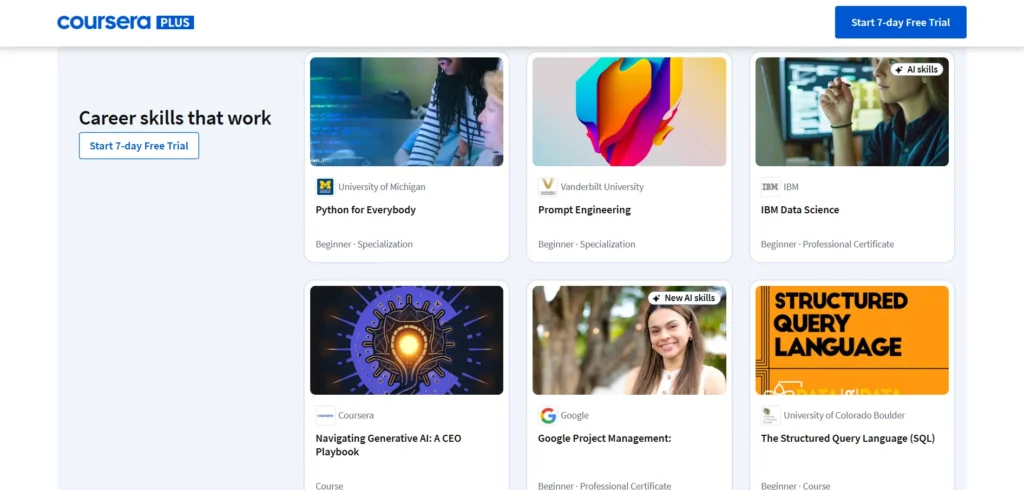
Here’s a deeper look at five popular programs, how they stand out, pros, and things to watch out for.
1. Google IT Support Professional Certificate
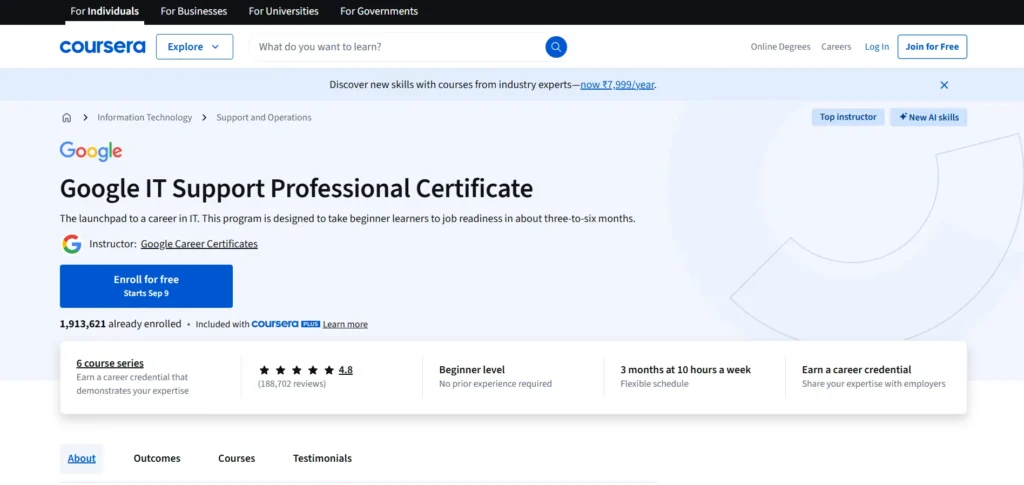
This program is widely recommended for people who want to break into IT support or helpdesk roles, often without prior formal IT education.
Strengths:
- Beginner-friendly structure, covering basics of hardware, software, networking, system administration, security.
- Hands-on labs and simulation tasks give practice, not just theory.
- The Google name adds credibility when you list it on your resume.
- Many users say it gives tangible confidence in technical troubleshooting skills.
Challenges:
- Entry level roles emerging from this certificate often pay modestly, so it’s a starting point, not a high-salary ticket.
- To get real job traction, you’ll need to add experience, internships, or side projects.
- If you have a full schedule, completing assignments and labs might feel demanding.
Many users report they learned a lot and used this to build technical foundations.
2. IBM Data Science Professional Certificate
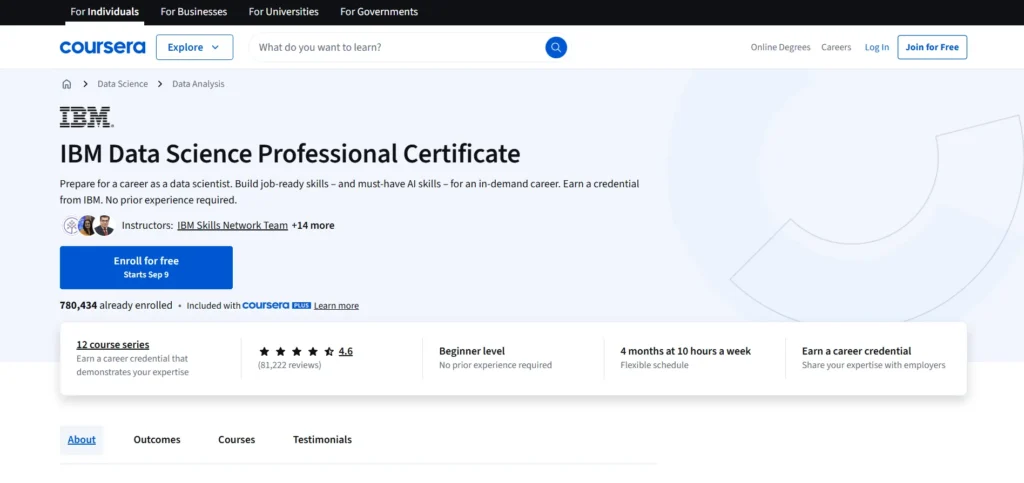
This is a more ambitious path aimed at learners who want to move into data roles. It covers Python, data wrangling, visualization, machine learning basics, and a final project or capstone.
Strengths:
- Good breadth. You get exposure to multiple tools and methods.
- The capstone / project helps you build something you can showcase in portfolios.
- IBM’s brand gives this certificate weight.
- It’s a solid stepping stone for people shifting toward data/analytics careers.
Challenges:
- Because the path is broad, it may not achieve very deep mastery in every topic. To go further, additional specialization is needed.
- You must be consistent. Falling behind can increase your cost (if subscription-based) or delay completion.
- As always, certificate alone isn’t enough — your real work (projects, experience) matters more.
This program often gets praise from learners who felt it gave them enough grounding to explore data roles.
3. DeepLearning.AI Machine Learning Specialization
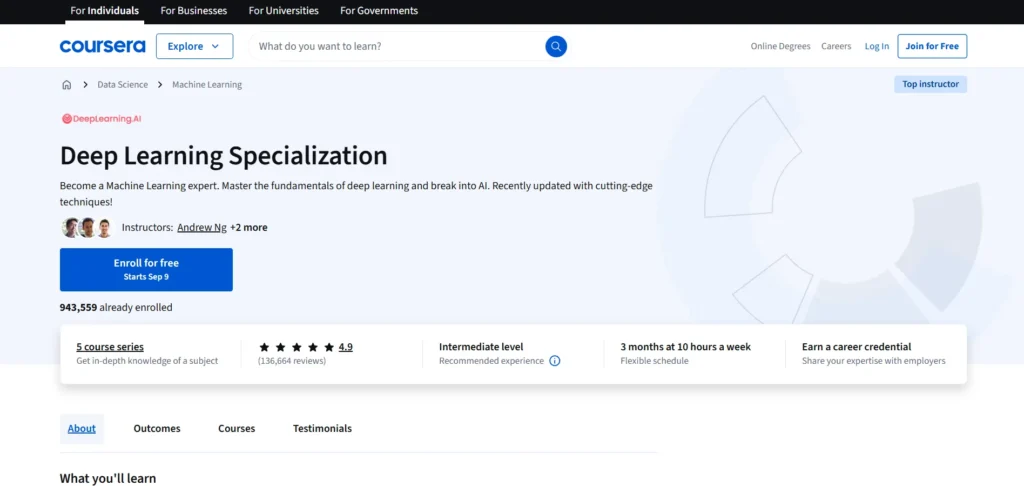
This track is more advanced, often recommended for those with some programming or math background, wanting to go deeper into machine learning and neural networks.
Strengths:
- High reputation. It’s tied to known experts and has theoretical rigor.
- Mix of theory + practical coding + project work.
- Useful for people serious about AI / ML careers, not just surface knowledge.
Challenges:
- If you don’t have sufficient math or coding base, parts may be hard to digest.
- Rapid progress in AI means you must supplement with newer resources to stay current.
- This specialization may not always be included under subscription access, so double-check cost before enrolling.
Students often say it transforms their understanding of machine learning beyond surface tools.
4. University of Michigan: Python for Everybody Specialization
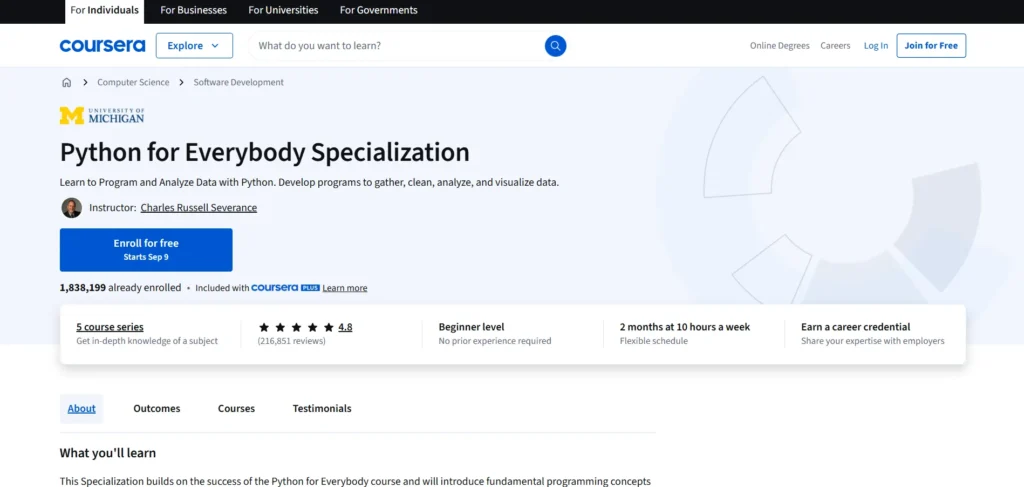
This is more beginner-level and is frequently recommended for people without any programming experience.
Strengths:
- Gentle, clear pacing, designed to reduce intimidation.
- Good for developing confidence in coding basics, logic, syntax, control structures, etc.
- Many learners use it as a springboard into more advanced machine learning or web development.
Challenges:
- Because it’s introductory, by the end you’re still at basic or intermediate level. You will need follow-up work to become job-ready.
- Some learners may find sections too slow if they already have some exposure.
Overall, many praise this as an excellent foundation program to get into programming.
5. Google Project Management Professional Certificate
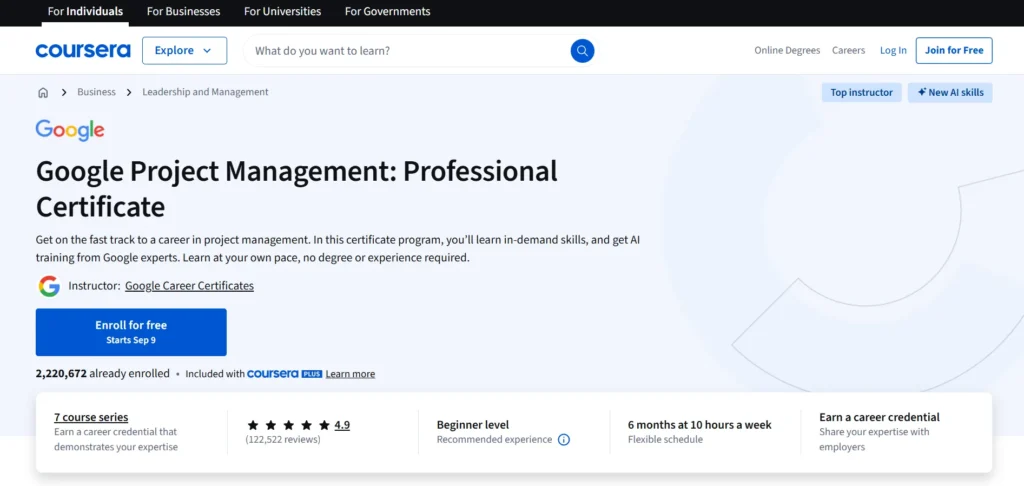
This is a non-technical but highly practical pathway for people who aim to work in project roles. You’ll get exposure to frameworks, tools, stakeholder management, agile, etc.
Strengths:
- Very usable skills. Things you learn here (planning, risk management, agile) are relevant across many fields.
- The Google brand gives it credibility.
- Strong mix of theory and practical templates, exercises, case studies.
Challenges:
- In competitive markets, many project roles require domain experience beyond just certificate knowledge (e.g. domain in tech, finance, etc.).
- You’ll succeed more if you can show real project work, even small ones, not just certificate credentials.
- Some sections may feel basic if you already had project exposure.
Still, as a non-technical route with practical value, many learners find this certificate useful.
Pricing & Costs in 2025
Understanding cost is critical, because many users feel blindsided by hidden fees, subscription quirks, or refund policies. Here’s how pricing typically works in 2025.
1. Individual Courses
- Many Coursera courses offer free auditing: you can watch lectures and read materials, but you won’t be able to submit assignments or get a certificate.
- To unlock full access (graded assignments, peer review, certificate), you pay a one-time fee. For many courses, this starts from around US$49, though higher for some advanced or professional ones.
- Some “guided projects” (short, focused tasks) are priced lower (for example, ~$9.99 depending on region).
If your goal is just to learn content and not care about certification, auditing many courses is a good option. But if certificates matter, you’ll need to pick what to pay for.
2. Specializations & Professional Certificates
Because these cover multiple courses, Coursera often uses a subscription model:
- You pay monthly until you complete the entire program.
- Rates often start around US$49/month (but can vary by region and program).
- The faster you finish, the less you pay overall; delays increase cost.
This gives flexibility but rewards consistency. It’s especially useful if you can commit effort and finish within a few months.
3. Coursera Plus (Subscription Model)
This is a powerful option for people who expect to take many courses.
- Coursera Plus typically costs ~US$59/month, or an annual plan (which works out to ~US$399/year under normal pricing).
- It gives you access to a large portion (often over 90 %) of Coursera’s courses, specializations, and certificates without needing to pay course-by-course.
- Not all offerings are included (degree programs, some advanced certificates tend to be excluded).
- There is often a free trial (7 days) or money-back guarantee window when you sign up.
Because the subscription is flat, if you take many courses in a year, Coursera Plus can save you money versus paying course by course.
But some users complain that the subscription makes them feel pressured to consume courses quickly just to “get value.” That can backfire if you stretch yourself too thin.
4. Degree Programs
Coursera also lets you enroll in fully accredited degrees (bachelor’s or master’s), in partnership with universities.
- These are priced more like traditional online degrees, often in the range of thousands to tens of thousands of dollars depending on university and region.
- You pay term by term, not via the subscription model.
- Because these are real degrees, they often come with higher stakes (admissions standards, deadlines, etc.).
If your aim is a formal degree, Coursera offers a competitive option, especially if the partner university is reputable and the cost is lower than on-campus alternatives.
5. Refunds, Trials & Guarantees
- Many paid courses or subscriptions come with a refund window (often 14 days) under certain conditions (e.g. you haven’t earned a certificate yet).
- Discounted or promotional purchases may have special terms.
- Coursera Plus generally offers a trial or refund window for new subscribers, but conditions (e.g. you must not have earned a certificate during that period) apply.
- Users report difficulties in canceling and refunding in some cases — this is one of the more common complaints in public reviews.
In short: check refund policies carefully before purchasing.
Pros of Coursera
Below are the major advantages users frequently highlight.
Credibility & Brand Partnerships
Because Coursera partners with recognized universities and major companies, the content and certificates tend to carry more weight than random online courses. Many learners find the institution name (e.g. Michigan, Google, DeepLearning.AI) valuable when listing credentials.
Flexibility & Self-Paced Learning
You can often learn at your own speed, and balance courses with full-time work, family, or other commitments. That flexibility is often cited as a major reason people choose Coursera over traditional options.
Wide Catalog & Variety
From beginner courses to advanced degree programs, Coursera offers a breadth that few platforms rival. You can explore different fields, pivot your learning direction, and mix technical and non-technical subjects.
Certificates and Degrees
Completing paid courses or programs gives you certificates that you can showcase on resumes, LinkedIn, or portfolios. If you enroll in degree programs, you can earn full academic credentials. For many learners, one of the big draws is getting something to show for your effort.
Financial Aid & Free Audit Options
Coursera offers financial aid on many courses. You can apply by submitting a short application explaining your situation. If approved, you may get full access at reduced or no cost.
Additionally, many courses allow you to audit them for free (though without certification or graded assignments). That lets you evaluate content before paying.
Cons and Cautions
No platform is perfect. Here are risks, downsides, and areas to watch out for.
Cost & Subscription Complexity
Many users report confusion over Coursera’s pricing structure, hidden fees, and surprise renewals. Some complain about difficulty canceling or requesting refunds. In Trustpilot reviews, “difficult to cancel” and “unhelpful customer service” appear frequently.
A user review on Trustpilot said: “Very difficult to cancel and get refund … No phone number to call …”
Inconsistent Quality Across Courses
Because courses are made by many institutions and instructors, quality isn’t uniform. Some courses are excellent; others are weaker in structure, clarity, or substance.
In user forums, people report that in some professional certificates the instructor just states what to learn instead of demonstrating. One Reddit user said:
“In some Professional Certificate, the lecturer just say what you need to learn and didn’t bother demonstrate how you do it … It’s super easy to learn when you show how to do it.”
Peer-graded assignments sometimes draw criticism: because submissions are graded by other learners, you might see very old assignments showing up for review, or inconsistent feedback.
Limited Personalized Interaction
You rarely get direct face-time with professors or personal mentoring. Interactions are mostly via discussion forums, peer reviews, or teaching assistants (if provided). For learners who prefer one-to-one guidance, this can be a drawback.
Variable Recognition of Certificates
While many employers value Coursera credentials (especially those tied to known universities or brands), not all certificates carry strong weight. In some industries or competitive roles, lesson knowledge and portfolio work may matter more than certificate badges.
High Dropout / Attrition Rates
A well-known challenge of online education is low completion rates. Many learners enroll but don’t finish. If you lack discipline or specificity in goals, you might abandon courses before finishing.
Customer Support Frustrations
Many complaints in review sites center on support. Users cite poor responsiveness, difficulty resolving billing issues, and challenges with refund or cancellation processes. In some cases, courses or subscriptions did not cancel cleanly and charges continued.
From ConsumerAffairs: one complaint described being charged even after canceling a free trial.
What Users, Reviewers & Research Say
It helps to see how others experience Coursera in 2025.
Public Reviews & Ratings
- On ConsumerAffairs, some users complain about poor customer service, confusing charges, and difficulty canceling subscriptions.
- On Trustpilot, many reviews highlight problems around billing, account access, and slow support.
- On Reddit, active users often praise the content itself, while warning about peer grading, inconsistent support, and the need to self-manage.
One Reddit comment captures a balanced view:
“You can learn and accomplish anything you do in Coursera in your own pace … A lot of Professional Certificates are actually well-made … majority of certificates don’t give a Credly badge … but you still have your Coursera profile … I learned a lot from Coursera.”
Another critical note from Reddit: reviewers sometimes grade assignments from years ago when there’s a backlog of peer reviews.
Some review sites like Upskillwise note that while many users give 5-star reviews for course quality and financial aid, a large share of 1-star reviews complain about billing, subscription issues, and customer support.
Review platforms like TrustRadius and Gartner Peer Insights generally cast Coursera favorably, praising self-paced learning, tracking of progress, and broad content.
Expert / Platform Reviews
- BitDegree gives Coursera a strong rating (9.1 / 10), highlighting flexibility, degree programs, and content quality, but notes pricing is complex.
- Upskillwise lists “complicated pricing” as a key downside, and cites many users’ frustration with billing and support.
- Cultural-Science’s breakdown shows individual courses ranging from $49 up to thousands (for advanced/degree programs), and underscores that Coursera Plus can be a smarter option for frequent learners.
- Some commentary in Coursera vs Udemy comparisons argues that Coursera often offers better long-term value and credibility, while Udemy wins in ultra-cheap, one-off courses.
Verdict: Is It Worth It in 2025?
Here’s where I land, after reviewing pros, cons, user feedback, and pricing.
Yes — It Can Be Worth It, If You Use It Strategically
Coursera is likely worth your time and money in 2025 if:
- You choose courses or programs aligned with your career goals.
- You move steadily, complete assignments, and build a portfolio.
- You take advantage of subscription models (Coursera Plus) if you plan to take many courses.
- You use financial aid or audits where helpful.
- You don’t rely solely on certificates — your real work (projects, experience) will matter more in job discussions.
Coursera’s advantages — credibility, variety, flexibility — are real. If approached smartly, it offers a strong return on investment for many learners.
But It’s Not a Free Lunch
If you aren’t consistent, if you treat it casually, or if you assume certificates alone will unlock jobs, you may be disappointed.
Also, the friction in pricing, refunds, and customer support means you must be careful, read terms, track subscriptions, and avoid surprises.
My verdict: For motivated learners aiming to gain real skills and credentials, Coursera remains one of the better bets among massive online platforms in 2025.
FAQs
Can I audit Coursera courses for free?
Yes — many courses support free auditing, allowing you to view video lectures and readings. But to submit assignments, get a certificate, or access some features, you’ll need to pay or upgrade.
Does Coursera offer financial aid?
Yes. For many paid courses, Coursera lets learners apply for financial aid by submitting a request explaining their circumstances. If approved, you can gain full access at lower or no cost.
Is Coursera Plus worth it?
If you intend to take multiple courses or programs in a year, yes — the flat subscription often beats paying course by course. But if you plan to take just one or two courses, paying individually may be cheaper.
Can I get a full degree on Coursera?
Yes. Coursera offers partner university bachelor’s and master’s degree programs, with credits, standards, and certification equal to on-campus equivalents (depending on the university).
What if I don’t finish the specialization I enroll in?
You can pause or cancel, but your cost is proportional to time spent if it’s subscription-based. Completed course certificates remain valid if you paid.
Will a Coursera certificate get me hired?
It can help — especially in tech, data, and emerging fields — but certificates usually work best when backed by actual projects, experience, and a strong resume. Many employers look for demonstrated ability rather than just a certificate.
How do refunds work?
Many paid courses and annual subscription plans offer a refund window (often 14 days) under certain conditions (e.g. you haven’t earned a certificate yet). Always read the refund policy before purchase.