
Online education has matured. What once felt experimental now serves millions as a real route to skills, credentials, and career change. Two names dominate the conversation: Coursera and edX. They share many similarities—both started in the MOOC era, both partner with universities, both offer free auditing options—but they differ in philosophy, execution, pricing, quality control, and employer recognition.
Here’s the roadmap: Let’s dive in.
Overview of Coursera
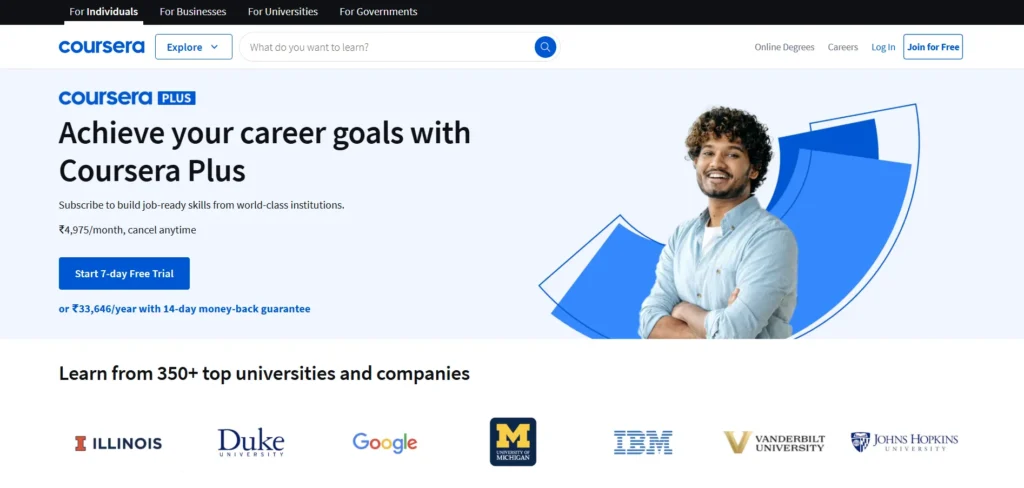
Coursera began in 2012, founded by two Stanford professors, with a vision of democratizing access to high-quality university courses. Over the years, it has evolved beyond the early MOOC approach. Now it is a broad education platform that offers:
- Individual courses (with audit vs verified/graded track)
- Specializations (bundled multi-course tracks)
- Professional certificates created in partnership with tech firms
- Full online degrees (master’s, etc.)
- Corporate training through “Coursera for Business”
As of recent reviews, Coursera is still praised for a clean interface, broad catalog, and strong partnerships, though users often critique parts like customer support and subscription complexity. (Reviewers say its interface is easy to use, content is solid, and pricing is relatively transparent, though complaints around billing, support, and glitches persist.)
Coursera positions itself as a bridge between learners and careers—i.e. it leans heavily on “you’ll gain skills you can use now, or credentials you can showcase.”
Overview of edX
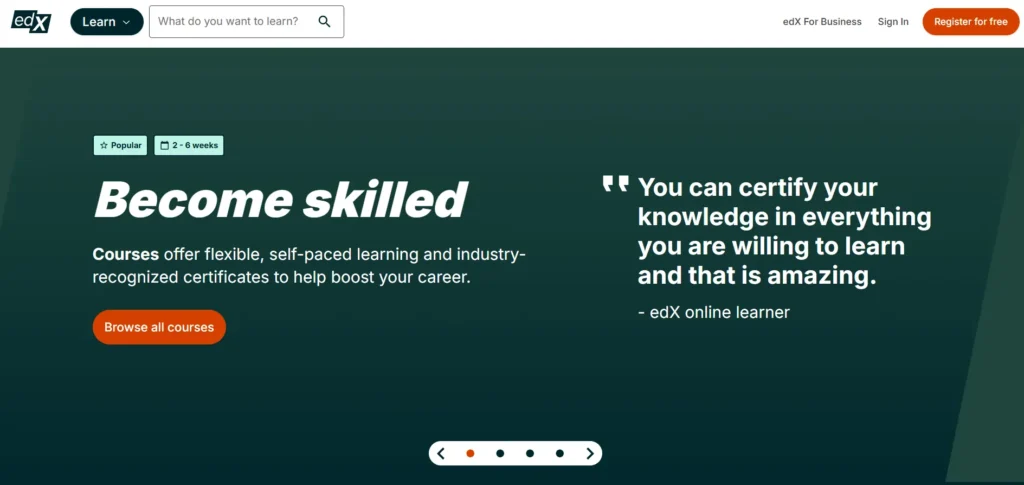
edX also launched in 2012 (by MIT and Harvard) with a somewhat more academic ethos. It has traditionally focused on university-style courses delivered online, maintaining some of the feel of formal academic instruction but in an open, flexible format. edX promotes audit access (free viewing of lectures/materials) and verified tracks (paid) for certificate and assessment purposes.
Over time, edX introduced micro-credentials such as MicroMasters, MicroBachelors, and industry-aligned professional tracks. It also partnered with institutional players and underwent structural shifts (e.g. integration with external education services) that influence how it manages content, pricing, and branding.
edX tends to emphasize rigor, theoretical foundations, and the university affiliation of its courses. But that background sometimes creates friction in agility, in consistency of course quality, or in how well the materials map to practical skill demands.
Course Offerings
A key way to compare these platforms is by looking at what you can learn, how deep you can go, and how well the curriculum is structured.
Coursera’s Course Catalog
Bread and depth
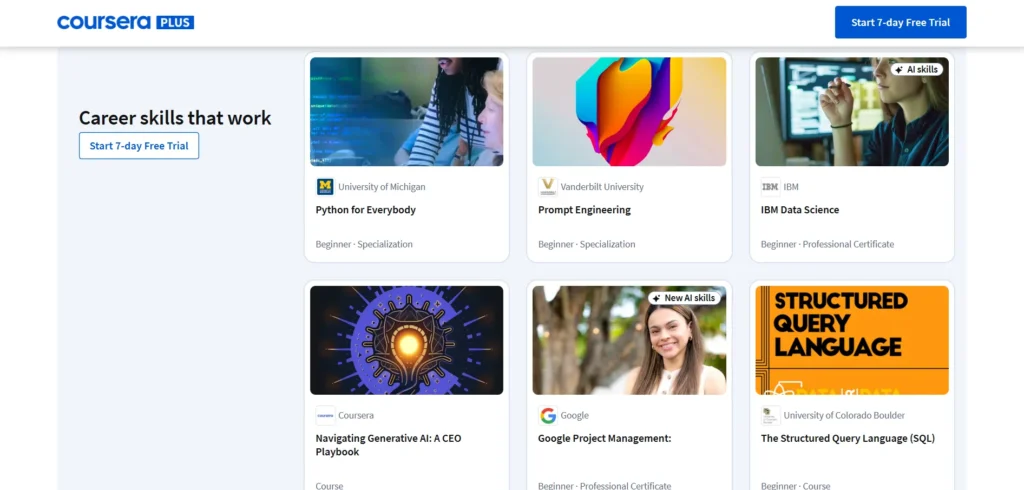
Coursera offers a very wide variety: data science, AI, computer science, business, health, humanities, languages, arts, and more. Because it partners not just with universities but with industry players (Google, IBM, Meta, etc.), many courses or certificates aim to align closely with employer needs.
Learning paths
The “Specialization” model is central. You enroll in a set of sequential courses, often with hands-on projects and capstones. You pay monthly until you complete. Many learners appreciate having a guided path rather than picking random courses.
Projects and applied work
Coursera strongly emphasizes project work, real datasets, peer-graded or auto-graded assignments, and in many cases an end project or capstone. This helps ensure you don’t just watch lectures—you build something tangible.
Degrees and credentials
Coursera offers full online degrees (bachelor’s and master’s) in partnership with universities, which gives it an edge in terms of offering “academic credentials” via MOOC infrastructure.
Audit mode
Most courses allow free audit access (lectures and reading materials) but exclude graded work, peer review, or certificates.
Limitations
Because the catalog is broad, not every course is deep or niche. For highly specialized or bleeding-edge technical topics, the depth may be limited. Also, maintaining quality across thousands of courses is a big challenge, leading to variability in student experience.
edX’s Course Catalog
University-level structure
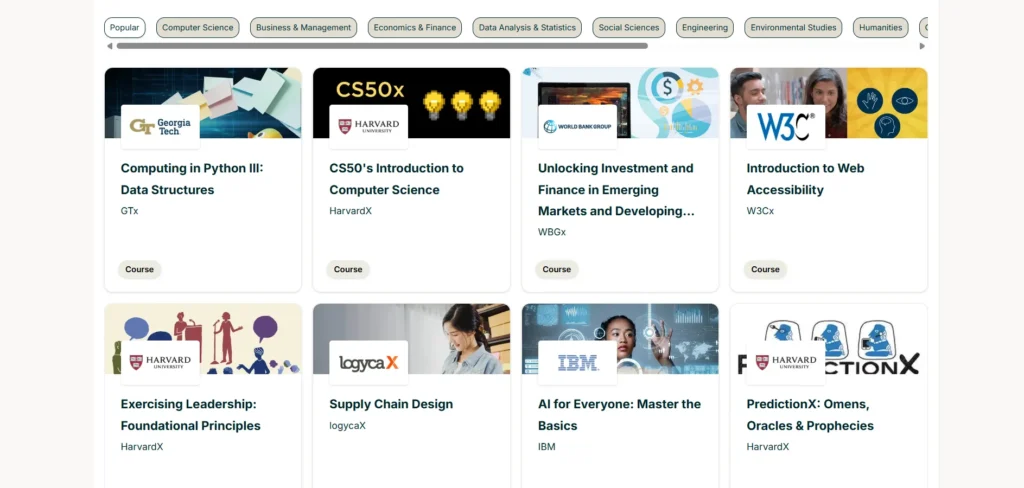
Many edX courses are mirrors (or adaptations) of on-campus university courses, complete with problem sets, reading assignments, often strict pacing, and structured assessment. This can feel more formal and rigorous.
Micro credentials
edX’s MicroMasters and MicroBachelors let learners assemble credential stacks that approximate portions of university degrees. This gives learners a modular path toward deeper study.
Audit vs Verified
Like Coursera, most edX courses can be audited for free (view lectures, read materials). If you want graded assignments, assessments, and a certificate, you must pay for the verified track.
Range of subjects
edX covers a wide range—STEM, humanities, social sciences, data science, policy, languages, etc. But in many reviews, its strength is considered in foundational and core academic disciplines, rather than hyper-specialized tech niches.
Quality variation
Because edX aggregates content from many partner institutions, the style and rigor can vary significantly. Some courses are stellar; others feel weaker or less polished. Learner reviews often mention disparities between the “star” courses and the average ones.
Slower innovation
Because of its academic roots and slower bureaucracy, edX sometimes lags behind in launching bleeding-edge content or adapting fast to industry shifts.
Partnered tracks
edX also collaborates with organizations such as the Linux Foundation to host domain-specific professional tracks (e.g. open source software development, Linux, Git). These become bridging zones where edX’s academic heritage meets industry relevance.
Pricing and Financial Aid
One of the most confusing areas for learners: how much does it cost, and how much flexibility and aid are available?
Coursera Pricing
Audit option (free)
Most courses let you audit—access lectures and materials without paying. However, you will not get graded assignments or the certificate.
Pay-per-course or specialization subscription
For full access (graded work + certificate), you typically pay per course or via subscription for specializations. Monthly subscription fees often fall between $39 and $79, depending on the specialization track. Some single courses charge a flat fee.
Coursera Plus
A subscription plan (annual or monthly) that gives access to many courses and certificates. It covers a large portion of the catalog under one subscription. Some reviewers emphasize that, if you plan to take multiple courses over a year, Coursera Plus can be “cost-effective.”
Discounts, financial aid, scholarships
Coursera offers financial aid or scholarships for many courses; learners can apply and, if accepted, receive a waiver or discount. Many satisfied reviews point out that this helps make expensive courses more accessible. Still, approval isn’t guaranteed.
Complexity and hidden costs
Some learners complain about confusing billing, auto-renewals, and difficulty canceling subscriptions. Indeed, in negative reviews, billing and customer support problems appear repeatedly.
edX Pricing
Free audit track (most courses)
As with Coursera, edX offers a free audit track for many courses, letting you access lectures and reading materials. But this excludes graded assessments and certificates.
Verified track
To earn the certificate or complete graded assignments, you pay for the verified track. The price may vary depending on the course, institution, or credential type.
MicroMasters, MicroBachelors, Professional programs
These higher-tier credentials come with larger price tags, often broken down by modules or courses. Some programs offer payment plans.
Financial assistance
edX provides financial assistance (discounts) for learners who apply. The discount rate is typically a percentage (like 50%) off the verified track cost, subject to eligibility.
Course cost transparency
Some learners find edX’s price model more predictable: a given course has a verified price, you know what you pay, and that’s it. But for stacked programs (e.g. MicroMasters), the cumulative cost can become substantial.
Customer Support, Quality Control & User Experience
Courses and pricing are only part of the story. What about how well the platforms are run, how consistent the experience is, and how responsive support is? This is where differences often surface in reviews.
Coursera Customer Support & Platform Experience
Strengths
- Smooth UI and navigation, mobile apps, downloadable lectures, and offline mode are consistently praised.
- Because Coursera is commercial and competitive, it iterates quickly—bug fixes, new features show up regularly.
- Its certification and credential management interface is polished.
Weaknesses and complaints
- Many negative reviews focus on poor customer support—slow or unhelpful responses.
- Billing issues, subscription cancellations, and auto-renewal frustrations are recurring pain points.
- Because the catalog is huge, quality varies; some courses feel rushed or inconsistent.
A reviewer in 2025 noted: “bad customer support, billing and subscription issues and technical problems.” (One-star reviews often cite that “the content is fine, but support is terrible.”)
Other users on forums mention the peer-grading system and lack of oversight in courses as potential flaws (i.e. the platform allows educators to publish with limited oversight).
edX Customer Support & Platform Experience
Strengths
- edX’s academic affiliation and nonprofit heritage cultivate trust in course rigor.
- The platform is stable, predictable, and structured. Many courses mimic familiar academic pacing, which some learners find reassuring.
- The audit/verified separation is clear and standardized.
Weaknesses and complaints
- Users sometimes report slower responsiveness in support, especially for non-top-tier or partner courses.
- Because course production is delegated to institutions, there’s more variance: some courses skip usability polish (e.g. clunky quizzes, unclear instructions).
- Innovation (new features, interactivity, modern UI tweaks) can lag.
Quality Control, Instructor Consistency, and Content Refresh
This is a critical domain for serious learners.
- In both platforms, since many courses are created and maintained by partner institutions or corporates, consistency is a challenge. Some courses are great, some are mediocre.
- Updates and refreshes depend on the partner. Some courses become stale (outdated content, broken links, old datasets) if not actively maintained.
- Peer reviews (student grading) are used in many assignments; this introduces noise and bias in grading quality.
- For technical courses, labs, programming environments, and sandbox infrastructure must be managed carefully. When they fail, learners get frustrated.
In contrast, Linux Foundation’s training and certification offerings tend to maintain high standards across technical depth, infrastructure (labs, virtual environments), revision cycles, and alignment with industry advances. Because it is a mission-driven domain entity rather than a generalist aggregator, it can invest resources more tightly in niche, deeply technical curriculum.
Employer Recognition, Certificates, and Real-World Value
Learning online is useful, but what matters is whether credentials are respected, skills are usable, and whether the learning translates into employability or advancement.
Coursera’s Strengths in Recognition
- The tie with universities and big tech partners gives Coursera certificates credibility. Employers often see “Coursera specialization from [X university]” as more legitimate than a random badge.
- Some MOOCs on Coursera have been studied: a 2024 research study found that learners who shared credentials were more likely to land jobs in relevant fields. (The study showed that certification sharing increased job uptake by 6% in relevant fields among learners in emerging markets.)
- Having full degree programs adds weight: if you obtain a master’s from a known university via Coursera, that holds up reasonably in hiring contexts.
But there are caveats: Someone scanning your resume sees “Coursera Certificate” and may still ask depth questions. The certificate by itself is rarely enough; you must back it up with portfolio, projects, understanding.
edX’s Strengths in Recognition
- Because many edX courses are directly from MIT, Harvard, or other top universities, the course name carries weight. A certificate “edX — MITx Course” can be impressive.
- MicroMasters and stacked credentials are sometimes accepted as credit toward full degree programs (depending on institution). This gives them real academic value.
- For deep theoretical or research niches, an edX certificate backed by a strong institution can resonate in academic or strategic engineering roles.
Again, the certificate is a supplement, not a guarantee. Employers will test your understanding.
Final Verdict & Comparison Summary
Here’s a comparative table of strengths and weaknesses, then a verdict.
| Dimension | Coursera | edX |
|---|---|---|
| Catalog breadth | Very broad, covers many topics and domains | Broad but with stronger academic core |
| Structured paths | Strong specialization and project tracks | Micro credentials and stacked modules |
| Pricing model | Subscription, per course, Coursera Plus, financial aid | Verified tracks, financial assistance, module pricing |
| Support & platform UX | Strong interface, mobile, frequent updates; support complaints | Stable platform, clear audit/verified split; slower improvements |
| Certificate credibility | Good for generalist roles and when tied to universities | Strong in academic/technical roles, particularly with prestigious institution name |
| Depth / relevance for technical learners | Good in general tech, but may lack niche depth | Good in foundational and academic tech, variable in niche |
| Lab / performance assessments | Many courses have labs and assignments, but not always performance exams | Some labs, but performance-based certification less common |
| Update speed & relevancy | Moderate — depends on partner updates | Slower in some areas |
| Community / ecosystem integration | MOOC community, project forums, broad reach | University/academic community, partner networks |
Verdict
If you want a generalist, flexible, career-aligned education across many domains, Coursera is often a very solid choice. It gives you breadth, polish, strong credential alignment, and a good user experience.
If your interest is in rigorous academic content, university affiliation, structured credentials with academic weight, or foundational theoretical disciplines, edX is strong—especially if you care about stacking skills toward credentials or degrees.
In effect:
- Use Coursera when your path is broad or interdisciplinary (e.g. data science + business).
- Use edX when you want academic depth, university prestige, or modular credentials.
FAQs
Can I audit all courses on Coursera and edX for free?
You can audit many courses (i.e. view lectures and content) for free, but you’ll lose access to graded work and certificates.
Are Coursera or edX certificates recognized by employers?
Yes, especially when backed by strong universities or industry partners—but they’re best when paired with demonstrated skills and projects.
Is Linux Foundation training free?
Many Linux Foundation courses are free in audit mode; you typically pay only for verified certification or exams.
Can certifications by the Linux Foundation boost my job prospects?
Absolutely—especially in roles centered on Linux, cloud, containers, DevOps, or open source infrastructure.
Which platform is better for tech beginners vs advanced learners?
For beginners, Coursera or edX are gentler; for advanced learners or specialists, Linux Foundation’s focused training is superior.