
If you’re looking to jump into social media marketing and want a structured route—even with zero experience—the Meta Social Media Marketing Professional Certificate is often recommended. But does it live up to the hype? In this review, I’ll walk you through what the course is, what you’ll learn, the cost, real user feedback, its strengths and drawbacks, and whether I think it’s worth your time.
What Is the Meta Social Media Marketing Professional Certificate?
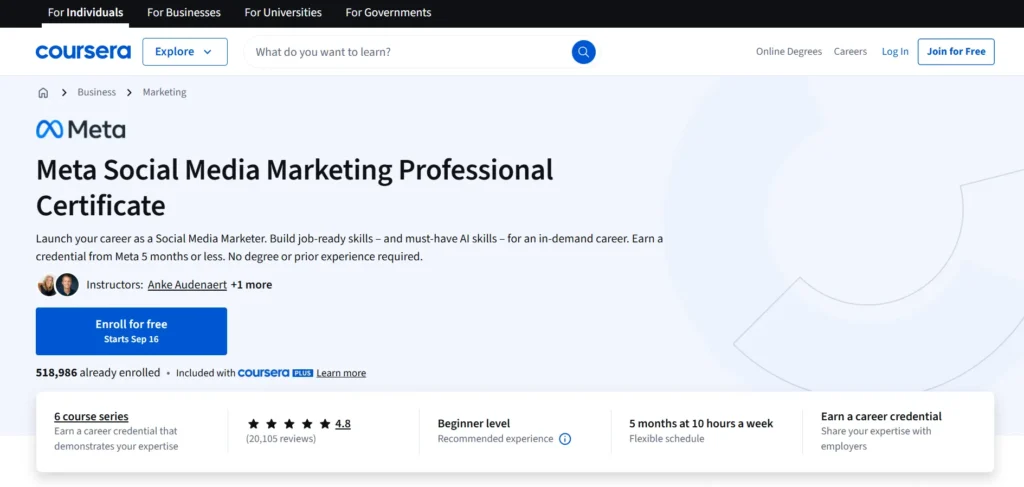
This is a training program offered through Coursera, created by Meta (the company behind Facebook and Instagram), in collaboration with educational partners. It aims to teach beginners the fundamentals of social media marketing, with a special emphasis on Meta’s own platforms (Facebook, Instagram, etc.). The idea is that, by the end, you have a portfolio—via a capstone project—and a credential (you also take a proctored exam called the Meta Digital Marketing Associate) that demonstrates your capability in social media work.
The program is fully online, self-paced, and designed for people with little to no marketing background. According to the course description, it’s meant to build skills over time so you can qualify for entry-level roles such as social media coordinator, digital marketing associate, social media specialist, etc.
On Coursera, this certificate is shown as “beginner friendly” and positions itself as offering a clear path into social media roles with measurable skills.
In reviews and course previews, it is clear that the lessons are prepared by Meta professionals and the structure is modular, meaning each course builds on the previous ones.
Course Breakdown
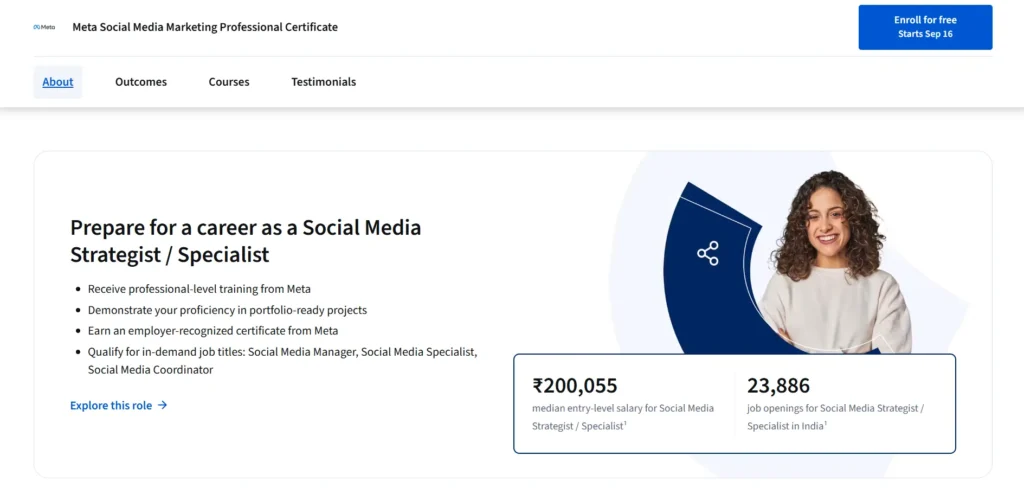
The certificate is made up of six separate “courses” (modules). Below is a breakdown of what each module tends to cover, how much work you might expect, and what you’ll take away.
1. Introduction to Social Media Marketing
This opening module sets the stage. Topics you’ll study include:
- What social media marketing means today
- The role of different social platforms (Instagram, Facebook, LinkedIn, TikTok, etc.)
- How to set goals for social campaigns (KPIs, SMART goals)
- How to define and understand your audience, crafting personas
- Customer journeys and aligning social content with those journeys
- How to choose platforms and creating a social media policy
This module is foundational. It ensures you’re fluent in the vocabulary and concepts that later lessons assume. Many learners say this is one of the more digestible modules.
Estimated learning time: approximately 15 hours (videos, reading, quizzes, exercises).
2. Social Media Management
With the foundation set, the second module shifts toward practical content work. You’ll cover:
- How to build a content calendar
- Designing posts (copies, visuals, short video) suitable for different platforms
- Maintaining brand voice, consistency, style guidelines
- Community engagement: responding to comments, moderation, building conversation
- Using analytics on content to judge what’s working and what’s not
This is where you start doing “real” tasks you would in a social media role. The assignments usually involve creating sample content, planning posts, etc.
Estimated time: around 12 hours worth of instructional material, plus assignment time.
3. Fundamentals of Social Media Advertising
Here the course introduces advertising. Topics include:
- Why paid media matters in social marketing
- Key ad components: creative, copy, targeting, budgets
- Working with design—from briefs to collaboration
- Running simple ads on Facebook and Instagram
- Data tracking, privacy, and compliance considerations
This module is crucial because many brands depend heavily on paid reach, not just organic content.
Estimated time: ~9 hours of content, plus assignments and quizzes.
4. Advertising with Meta
This module drills into Meta’s advertising tools. You will:
- Use Meta Ads Manager to build and launch campaigns
- Choose objectives, set budgets, schedule ads
- Select placements, design variations, test audiences
- Troubleshoot underperforming ads, adjust targeting and creative
Because Meta’s ad tools are complex and frequently updated, this module is deeper and more technical.
5. Measure and Optimize Social Media Marketing Campaigns
Once your ad campaign is running, this module teaches how to analyze and improve it. You’ll learn:
- Key metrics (impressions, CTR, ROAS, CPM, etc.)
- Attribution models, lift tests, how to interpret results
- A/B testing and creative experiments
- Optimization cycles—test, learn, improve
- How to present results to stakeholders
This module transforms you from someone who launches ads to someone who makes them better over time.
6. Meta Social Media Marketing Capstone Project
This is the hands-on project. You take everything you learned and build a full campaign strategy (content + paid). You simulate or run it, gather hypothetical or real results, analyze outcomes, and present insights. You also take the proctored exam, Meta Digital Marketing Associate, as part of this final stage.
The capstone is what lets you show something tangible to potential employers. Many learners say it’s the most important module for your portfolio.
Cost and Duration
Duration
Meta’s official suggestion is that you can complete the certificate in 5 months, assuming about 10 hours of effort per week. Because it is self-paced, some learners speed through while others take more time. Many reviews note that 6 to 7 months is more common when balancing other responsibilities.
In total, the course includes more than 70 hours of content (videos, readings, etc.). According to a review, you might spend over 70 hours doing just the learning portion, not counting assignments and exam prep.
Cost
The cost is tied to Coursera’s subscription model. The typical rate cited is about $49 per month. So if you finish in 5 months, you end up spending around $245.
Some reviews estimate a slightly higher total cost (for example, $273) because many learners take extra months to complete. The monthly subscription continues until you finish. Coursera also offers a 7-day free trial and financial aid for eligible learners, which can reduce upfront risk.
Given that the certificate doesn’t require one huge upfront payment but spreads cost across months, it’s somewhat flexible—but only if you stay on pace.
Who Should Take This Course?
This certificate is best for:
- Absolute beginners looking to break into social media marketing
- People changing careers and wanting a guided path
- Freelancers, side hustlers, or small business owners who need social media skills
- Job seekers wanting to add structure, portfolio work, and a credential
It may be less ideal for:
- Experienced marketers who already have hands-on experience
- Those whose focus is far outside Meta’s platforms (for example, exclusively TikTok or YouTube strategies)
- Learners who struggle with self-discipline or can’t commit consistent weekly hours
If your goal is practical skill plus something to show employers, this is a reasonable bet. But it’s not enough on its own.
Pros and Cons
Here’s a balanced look at what works well and what doesn’t.
Pros
- Beginner Friendly Structure: The lessons flow logically, starting from basics and gradually getting more technical. Many learners describe the course as “easy to follow” with clear videos and practical examples.
(According to a review, it is celebrated for being easy to follow and accessible.) - Hands-On Work & Portfolio Building: You don’t just watch videos—you’ll complete assignments and a capstone project, which gives you something to show.
- Meta Tools Exposure: Because it’s built by Meta, the certificate gives more direct insight into Meta’s ad tools, targeting, creative best practices, and troubleshooting.
- Recognizable Credential: The Meta name carries weight. Having a certificate tied to a major brand gives credibility to your resume.
- Self-Paced & Online: You can study from anywhere, at your own time, which helps those juggling jobs or other commitments.
- Access to Job Board & Career Tools: Many students mention that the program offers access to a Meta career job board (where companies post roles looking for social media skills).
- Strong Learner Ratings: The certificate has very high average ratings, indicating substantial satisfaction.
Cons
- Cost Can Rise If Delayed: Because billing is monthly, if you take extra months, you pay more.
- Meta Platform Bias: The eyes of the curriculum lean heavily toward Facebook and Instagram. If much of your future work is outside those platforms, you’ll need supplementary training.
- Not Advanced in Every Niche: Analytics, creative direction, influencer marketing, or custom strategies are not covered deeply. Some topics are introductory.
- Certificate Doesn’t Guarantee Jobs: A compelling pushback in forums is that many experienced professionals see certificates as nice extras—not proof of real ability. As one Reddit user put it, “Makes it look good on paper … certs are useless … can only give credibility but not substitution for real work.”
Real-World Feedback: What Learners Think
To give you a ground-level look, here’s what actual learners say.
- On Reddit, someone wrote:
“Makes it look good on paper but seriously, anyone experienced will know these certificates are useless… it can only give credibility but not substitution for real work.”
This captures an important caveat: certification helps, but you still need practical experience. - In the Reliablesoft review, the certificate is praised for being “easy to follow” with straightforward videos, practical examples, and clear structure. They call it “a great professional certificate to pursue.”
- According to course support forums, a learner who completed just the first module asked if that alone could help land a job. The response was realistic: finishing the introduction helps with knowledge, but to land a job you still need practical experience.
- Many learners say the lessons are digestible, with modular bites, visual tools, templates, and guided steps. That helps prevent overwhelm especially early on.
- Some mention that updates in Meta Ads interfaces sometimes outpace course updates. That gap is a frustration when you see a lesson telling you to click a menu that no longer exists.
- Several students say the certificate gave them confidence and credibility, but that interviews still required evidence of real outcomes or case studies beyond certificate completion.
Putting it together: learners generally find value in the structure, ease of learning, and tangible output. But most agree it’s not enough on its own—you must build real work to back it up.
Is the Meta Social Media Marketing Professional Certificate Worth It?
I believe it is worth it for many beginners—if used wisely. But it is not a magic bullet.
When It Is Worth It
- You’re at the start and need structure, guidance, and a credential
- You’re willing to do hands-on projects
- You are okay learning Meta’s ecosystem (because that gives you strength in Facebook/Instagram roles)
- You commit to regular weekly effort and won’t let it drag
- You pair it with self-initiated campaigns, small freelancing gigs, or personal brand work
In that scenario, the cost (say $245 over five months) is modest compared to gains in confidence, skills, and portfolio. The certificate helps you stand out among other job seekers with no formal training.
When It Might Not Be Worth It
- You already have solid social media marketing experience
- Your focus is mostly non-Meta platforms and you dislike spending time on Meta’s tools
- You cannot commit consistent time or will likely stretch the course over many months
- You expect the certificate alone to open doors without showing tangible work
In such cases, you might be better off investing in niche, advanced courses, paid challenges, mentorship, or going straight into building real campaigns.
So yes—the certificate is a strong tool in the beginner’s toolkit—but only if you treat it as one piece in a larger journey.
Conclusion
The Meta Social Media Marketing Professional Certificate offers a thoughtfully organized route into social media marketing. It gives beginners a clear path from theory to execution, with real assignments and a capstone project you can talk about in interviews. It also gives you exposure to the exact tools and systems many social media roles use (especially around Meta’s platforms).
The downsides—monthly cost if you delay, strong focus on Meta, content aging, and no job guarantee—are real, but manageable if you approach with a realistic mindset. The certificate works best when combined with consistent effort, self-initiated projects, networking, and a habit of updating your skills beyond the course.
If I were advising a friend just entering social media marketing, I’d say: yes, do it—but go in with intention. Treat it as your learning scaffold. Build your own campaigns, document results, reach out to small clients, and use that capstone as just one of many proof points in your portfolio. Do that, and you’ll likely turn this certificate into a stepping stone rather than just a badge.
FAQs
Do I need any marketing experience to start?
No. The program is designed for complete beginners with no prior marketing background.
How long does it take to finish?
Most learners complete it in about five months if they study around ten hours per week.
How much does it cost?
It costs roughly $49 per month on Coursera, so around $245 if finished in five months.
Will this certificate guarantee me a job?
No. It improves your skills and resume but doesn’t guarantee employment—you’ll still need real-world practice.
Is it focused only on Facebook and Instagram?
Yes, mainly. While it teaches general marketing principles, most of the practical training is based on Meta’s platforms.