
If you’re trying to build a career in digital marketing or simply want to sharpen your skills, Semrush Academy is one of the most accessible places to start. It’s a free online learning platform created by Semrush, a leading name in SEO and marketing analytics. The Academy offers a variety of courses that cover essential areas such as SEO, content marketing, paid advertising, and social media strategy. Each course is designed and taught by industry professionals, which gives the lessons a real-world edge rather than just textbook theory.
What makes Semrush Academy stand out is its combination of expert-led videos, interactive quizzes, and certification exams—all offered at no cost. Whether you’re a beginner exploring the basics or a seasoned marketer looking to refine your tool-based knowledge, the platform is structured to fit flexible, self-paced learning. Many learners appreciate that it focuses on practical marketing skills and keeps content updated with the latest trends and strategies.
In this in-depth review, we’ll look at the features, course options, pros and cons, and overall value of Semrush Academy to help you decide if it’s the right platform for your professional growth.
Overview of Semrush Academy
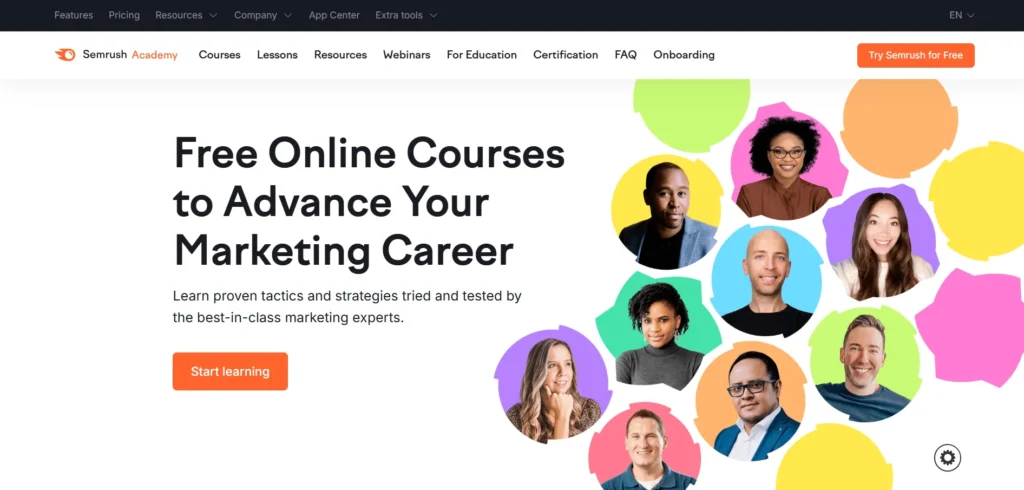
Semrush Academy is the learning arm of Semrush, the widely used SEO and marketing tools suite. It offers online courses focused on digital marketing — covering SEO, content marketing, social media, ads, and more — entirely for free.
Its aim is twofold: teach people how to use marketing principles and to understand how Semrush’s own tools function. You take lessons via video + reading material, answer quizzes, then pass an exam. Get the certificate, and you can show off that you’ve completed that specialization.
Users range from beginners who hardly know what “SEO” means, to marketing professionals who want hands-on knowledge of a toolset. Some praise its structure and affordability. Others feel parts of it lack depth or interactivity. I’ve gathered user feedback and firsthand observations to give a balanced view.
Features of Semrush Academy
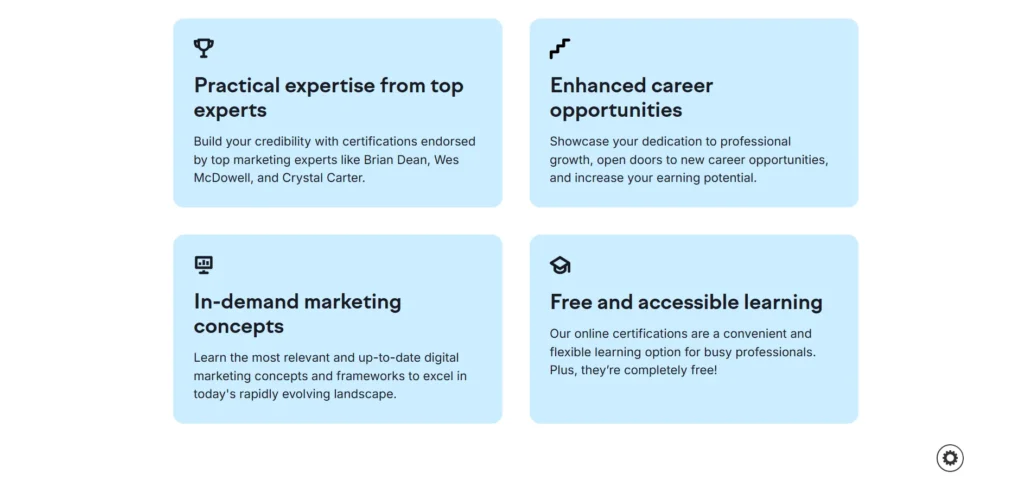
Let’s go feature by feature. What does it bring? What’s missing?
1. Free Access to All Courses
This might be the biggest draw: there’s no payment required. You don’t have to open your wallet to enroll, view videos, take exams, or earn certificates. Many learners mention this as the core advantage.
That said, “free” doesn’t always mean “perfect.” While the cost is zero, you still invest time — and that time should pay off.
2. A Wide Range of Courses
Semrush Academy doesn’t stick to one narrow subject. You’ll find courses in:
- Basic and advanced SEO
- Keyword research
- On-page SEO
- Content marketing strategies
- PPC / paid advertising
- Social media marketing
- Competitive research and market analysis
In fact, there are over 90 courses listed as of 2025. Some are short, meant to give a quick boost; others go deeper. (I saw this on course aggregation sites.)
This breadth is helpful because you can pick and choose topics you need rather than being forced into a curriculum you don’t care about.
3. Expert-Led Learning
Semrush brings in instructors who have credibility in the marketing world — folks who have done real SEO, run campaigns, or worked in agencies. Many of the courses are built or shaped by practitioners, not just theorists.
That gives the content a sense of “this is useful work you can do,” rather than just academic stuff.
4. Interactive Learning
It’s not just videos. You’ll find quizzes, multiple-choice exams, reading material, and downloadable resources. These help you test what you’ve learned rather than passively consuming.
However, many users say the “hands-on” component is limited. It’s possible to earn the certificate without doing real-world projects or deep simulations.
5. Certification
Once you pass the exam (you usually need around 70 % or more), you get a certificate you can download, display, or share. This gives you something tangible for your resume, LinkedIn, or portfolio.
Just don’t assume the certificate guarantees job offers — it’s more of a skill signal than proof of mastery. Users often say it shows dedication more than real capability.
6. Regularly Updated Content
Digital marketing evolves fast. Courses on SEO or social media can get outdated quickly. Many users appreciate that Semrush updates or refreshes content to reflect changes (e.g., algorithm updates, new ad platforms).
Still, even with updates, some parts feel dated — particularly examples or interface screenshots — depending on when you take them.
7. Community Support
Because Semrush is a popular marketing tool, there’s an active community. Learners can discuss through forums, social media, or groups. This peer support helps when you get stuck or need real-world perspectives.
In sum: you’re not totally on your own. But the level of direct instructor support or feedback is limited.
Courses Offered by Semrush Academy
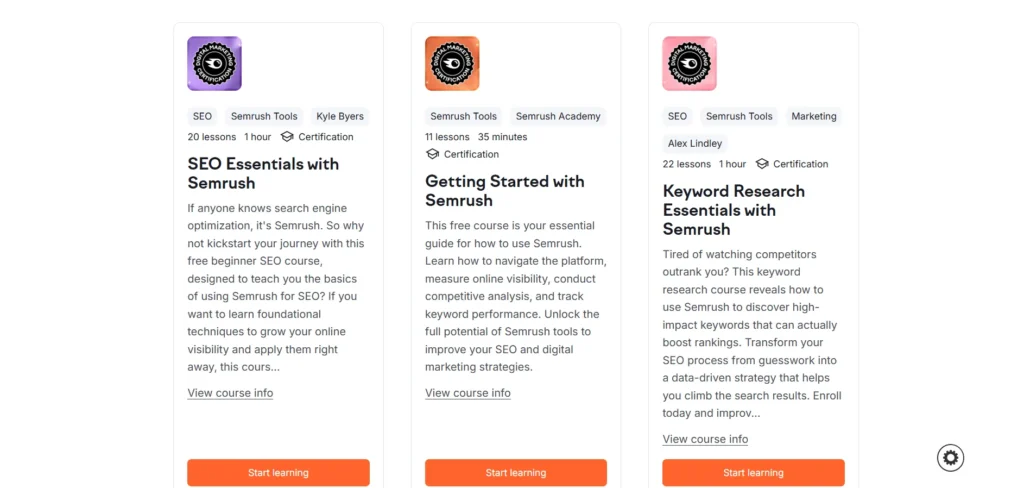
Let’s look at specific types of courses and what to expect.
1. SEO Essentials with Semrush
This is usually the starter course. It gives you core SEO principles — how search engines work, basics of on-page factors, how to conduct an SEO audit, etc. It’s a foundation many learners take first.
2. Keyword Research Essentials with Semrush
Focuses entirely on how to find the right keywords, assess competition, search volume, and picking terms that balance effort and reward.
This is one area where the tool-based approach shines, because you see Semrush’s keyword data in action.
3. On-Page SEO Essentials with Semrush
Here you dig into the optimization of HTML elements, page structure, meta tags, headings, internal linking — everything you can tweak on your page to help rankings.
4. Content Marketing Strategies
More than just SEO, this course shows how to plan, produce, and promote content that resonates with users and search engines. You’ll learn content calendars, topic clusters, writing strategy, and distribution.
5. Paid Ads with Semrush
Covers paid campaigns: setting up ads, bidding strategies, ad copy, tracking ROI, and optimizing your ad spend. Because many marketers juggle free and paid channels, this is often a valuable addition.
6. Social Media Marketing
This explores social media planning, content for platforms, analytics, and alignment with SEO/content goals. It helps bridge SEO and social — a useful angle since real marketing rarely lives in silos.
7. Competitive Research and Market Analysis
You learn to spy on competitors: seeing their keywords, backlinks, content, and ad strategies. This helps you benchmark yourself and find strategic gaps to exploit.
Together, these courses make a toolkit you can piece together based on where you want to grow.
Pricing of Semrush Academy
Good news: it’s free. All of it. No hidden fees or paid “premium” tier.
| Item | Price | Notes / Additional Info |
|---|---|---|
| Course Access | Free | You can enroll in and watch all available courses at no cost. |
| Certification and Exams | Free | Every course includes an exam, and the completion certificate is also free. |
| Account Requirement | Free Account | You only need to create a free Semrush account to access the Academy. |
| Tool Access for Practice | Optional Paid Plan | Some lessons demonstrate tools that require a paid Semrush subscription, but this is not mandatory to take or complete the course. |
Explanation
Semrush Academy runs entirely on a free-access model. You can take all its courses, complete tests, and download certificates without paying anything. The only optional cost comes if you want to use Semrush’s paid tools alongside the lessons, which can help you apply what you’re learning but isn’t required.
There are no hidden charges, upsells, or premium tiers inside the Academy itself. Everything needed for learning and certification is open and free for anyone who registers.
Pros and Cons of Semrush Academy
Here’s a no-fluff list of strengths and weaknesses, based on user experiences and my own evaluation.
Pros:
- Zero cost — everything is free
- Wide coverage — you can learn SEO, PPC, content, social, research
- Expert instructors — you hear from people who’ve done the work
- Flexible, self-paced format — fits busy schedules
- Tangible certificates — you get something to show
- Regular updates — content evolves over time
- Community / peer help — you’re not isolated
Cons:
- Limited hands-on project work — minimal “real world” simulation
- Lots of courses — hard to choose a path — beginners may feel lost deciding what to take first
- Depth varies — some modules are more surface-level
- Certificate is not a guarantee — it’s a signal, not proof
- Interface / examples sometimes dated — pictures or UI may not match current tools
Conclusion: Should You Enroll in Semrush Academy?
If you’re new to digital marketing or want to get tool-based skills without spending money, Semrush Academy is an excellent pick. It offers structured, credible courses across multiple topics, led by real-world practitioners, with certificates you can use as social proof.
If you’re already experienced and want deep, project-based learning or mentorship, you’ll probably use only the modules that refresh your knowledge.
In many cases, the cost-benefit ratio is very favorable: even if you spend dozens of hours, the total money spent is zero, and you’ll almost certainly learn something useful. So yes — I’d recommend enrolling, especially if your goal is to build a foundation or add specific skills in SEO, content, or marketing tools.
FAQs
Is Semrush Academy really free?
Yes — all core courses, quizzes, and certificates are provided at no charge.
Do I need a paid Semrush tool subscription?
No, not for most courses. Paid tool access may help you follow along in certain modules, but it’s not mandatory for learning.
How hard are the exams?
You generally need around 70 % to pass. Exams are multiple choice and meant to test comprehension, not rigorous project execution.
Does the certificate hold value?
It’s more of a credibility signal than proof of deep mastery. It shows you dedicated time to learning, which matters in some job contexts.
Can I skip straight to the exam if I already know a topic?
Yes — for many courses, you can take the exam directly and attempt to earn the certificate if you already know the content.
Are there alternative platforms I should consider?
Sure — there are free courses on platforms like Ahrefs Academy, many marketing MOOCs, and paid courses if you want mentorship or hands-on projects.