
If you’re on the fence about Udemy — wondering if it’s still worth your time, money, and effort in 2025 — welcome. This is the kind of review I’d write to a friend who wants to learn smart, not just buy courses blindly. I’ll walk you through what Udemy really is today, what works, what doesn’t, and whether you should pick it over other options. By the end, you’ll have a realistic view and some tips to get the most out of it.
What is Udemy?
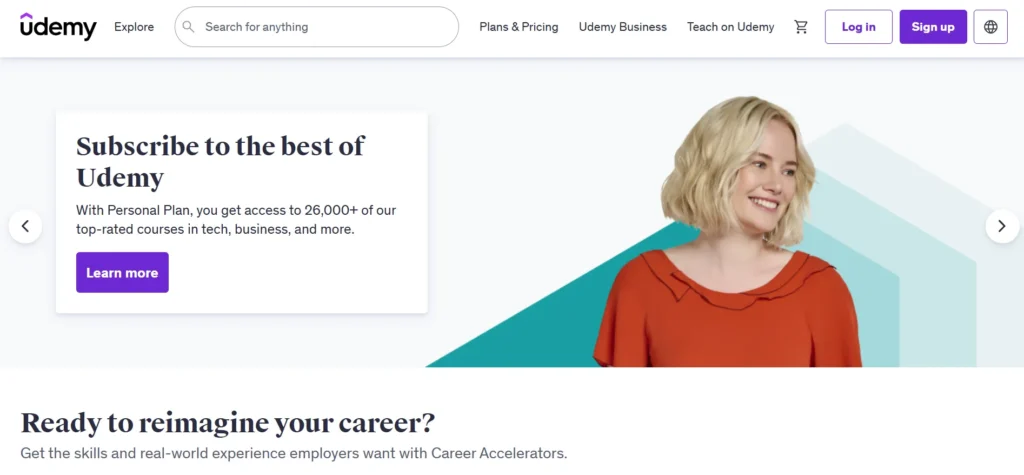
Udemy is an online learning marketplace. It is not a traditional university or degree-granting institution. Instead, it hosts courses created by independent instructors, covering a vast range of topics. Students browse, enroll, and study through recorded lectures, assignments, quizzes, downloadable resources, and communities like Q&A sections.
Since its founding in 2010, Udemy has grown into one of the most recognized names in the online education space. Its model differs from curated platforms: instructors can create their own courses (with some review), set their prices, and market them. Because of that, the catalog is enormous but uneven.
In 2025, Udemy also pushes subscriptions (for a subset of courses) and has a business / enterprise arm (for companies to train employees). But the core remains: you pick courses, you pay (or subscribe), and you learn.
As of now, Udemy claims to serve tens of millions of learners worldwide. Its appeal lies in flexibility, price, and variety. But those strengths also bring challenges. Let’s explore them.
Udemy Features: What Sets It Apart
Here are the features that define Udemy in 2025 — things people praise, things they warn about, and things you should know before you buy.
1. Vast Course Catalog
One of Udemy’s superpowers is sheer choice. You can find thousands of courses across programming, business, design, marketing, personal growth, hobbies, languages, and niche skills. Because its marketplace model invites many creators, new content appears all the time.
This variety means that whatever you want to learn — even weird or obscure topics — there’s a chance Udemy has it. But with that many options comes the challenge of filtering. Many reviews in 2025 emphasize that picking the right course is as important as picking a platform.
One downside to this open approach is that the catalog contains courses of very different quality. Some are excellent, polished, up-to-date; others may be outdated, superficial, or poorly structured.
2. Learning at Your Own Pace
Udemy’s courses are typically self-paced. There’s no fixed schedule or mandatory class sessions (unless an instructor adds something interactive, but that’s not common). You control when to start, stop, pause, and revisit.
If your schedule is unpredictable — work, family, travel — this flexibility is a big win. You don’t have to worry about missing classes or falling behind. You can go slow in some areas, fast in others.
However, this freedom demands discipline. If you thrive with structure — deadlines, peer accountability, cohort progression — Udemy may feel too loose for you.
3. Lifetime Access to Courses
When you purchase a course on Udemy (in the usual model), you often receive “lifetime access.” That means you can revisit lectures, materials, and (often) instructor updates indefinitely (or for as long as Udemy supports the content).
This is a major selling point versus subscription models, where losing the subscription means losing access. Many learners appreciate being able to come back months or years later for review or refreshers.
That said, “lifetime” has conditions. If an instructor removes content, discontinues updates, or reorganizes a course drastically, your experience might change. Also, if a course is part of a subscription or special plan, access rules may differ. It’s wise to check exactly what “lifetime access” means for the course in question.
4. Affordable Pricing
Udemy uses aggressive pricing. While many courses are listed at high price tags (sometimes $100, $200 or more), those are rarely the actual selling prices. Udemy frequently offers deep discounts, and many good courses are priced in the $10 to $25 range during promotions.
Because of that, many learners time their purchases around sales. You often see “Best Deal Today” banners, seasonal sales, or daily deals.
In addition, Udemy introduced a Personal Plan subscription model, which gives access to a curated pool of courses (not the entire catalog) for a recurring fee. This gives learners more freedom to explore without buying every course. But not all courses are included under subscription, so you may still need to pay separately for certain courses.
Most courses come with a 30-day refund policy — if you’re not satisfied, you can request a refund within 30 days. That safety net reduces risk, although actual refund experience can vary.
One caveat: because of dynamic pricing, course prices fluctuate. A course you see for $15 today might cost more on another day. That makes timing your purchase matter.
5. Mobile Learning
Udemy has mobile apps for iOS and Android. You can download lectures for offline viewing, track progress, resume from where you left off, and use your phone or tablet instead of a computer.
This is especially useful for commuting, travel, or learning in low-connectivity environments. Many users report that the app performs well, although occasional bugs, crashes, or glitches after app updates do appear in reviews.
6. Instructor Support and Engagement
An often-touted feature is the ability to ask the instructor questions via discussion boards, Q&A sections, or message features. In more active and responsive courses, instructors may answer doubts, add clarifications, or even update content based on student feedback.
However, engagement level is inconsistent. Because instructors vary widely in experience, time, and motivation, some courses have very active support, while others may hardly respond. Some instructors abandon their courses after launch and offer minimal support. Learner reviews frequently mention this as a weakness.
Thus, one course’s experience may feel individual and interactive; another may feel like a passive video dump.
7. Certificates of Completion
When you complete a course, you receive a digital certificate of completion. It can signal to others (employers, peers) that you invested time.
However, these certificates are not formally accredited. They don’t count as academic credits in universities, and many employers may not consider them equivalent to certified credentials. They’re best seen as symbols of learning, not proof of formal qualification.
Some reviews note that while certificates are meaningful for showcasing self-learning, their real value is in what you can do, not what a certificate says.
Types of Courses Offered on Udemy
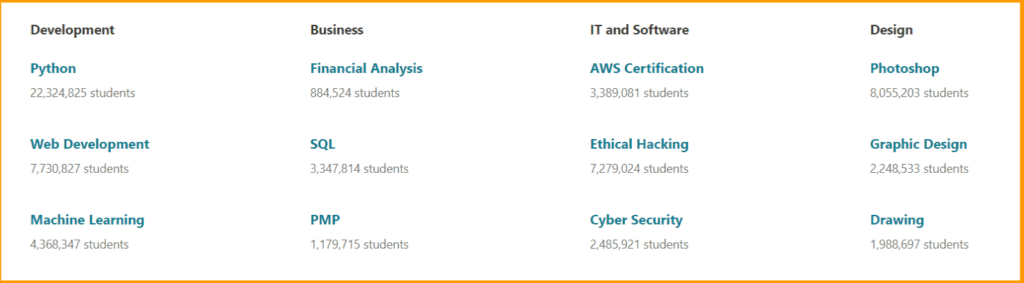
Because Udemy’s model is open, it covers many fields. Here are common categories and how they fare:
1. Technology and Programming
This is one of Udemy’s strongest domains. You’ll find courses in Python, JavaScript, full stack web development, AI, machine learning, data science, cloud computing, DevOps, and more. Many learners turn to Udemy precisely for tech upskilling.
Top instructors in tech fields often have high enrollments and well-polished content. But even here, quality varies. Some courses are exceptional, some are incomplete or outdated.
2. Business and Entrepreneurship
For marketing, sales, leadership, financial planning, project management, business strategy, startup fundamentals — Udemy has a large selection. This is useful for side hustlers, freelancers, or professionals who want to add business chops.
3. Creative Arts
You’ll find courses on photography, video editing, illustration, music production, animation, graphic design, writing, voice acting, and more. These often attract hobbyists or people building side incomes.
Creative courses can be fun, engaging, and visually rich, but sometimes they may lack depth depending on the instructor.
4. Personal Development
Udemy offers courses in productivity, time management, public speaking, memory, habits, meditation, goal setting, leadership, confidence. These tend to be shorter, concept-based, with motivational styling.
Because the barrier to creating such content is lower, these courses can swing from inspiring gems to cliché-heavy filler.
5. Hobbies and Lifestyle
For more casual learning: cooking, gardening, crafts, languages, fitness, self-defense, travel, etc. These are often lighter in time commitment and depth, but fun and enriching.
Hobby courses often have strong niche appeal.
Because of this diversity, Udemy can be a one-stop platform for many of your learning goals — but the experience you get depends heavily on the specific course and instructor.
Udemy Pricing: How Much Does It Cost?
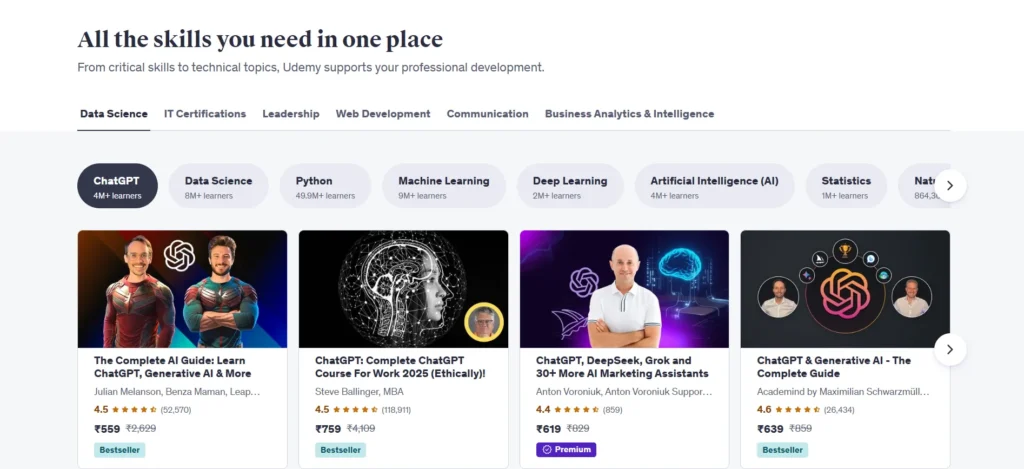
Understanding pricing on Udemy can be tricky, because of discounts, subscriptions, and course-by-course pricing. Let me break it down clearly.
Individual Course Purchases
- You pay once per course (unless it’s part of a subscription or special plan).
- The list price may be high (e.g. $100–200+), but actual selling price often during sales drops to $10–25.
- Discounts are frequent and deep; many courses go on sale regularly.
- After purchase, you typically retain lifetime access to that course.
- You may benefit from updates the instructor adds without extra cost.
Personal Plan / Subscription
- Udemy offers a subscription (“Personal Plan”) that gives access to a curated set of courses (e.g. 10,000+ or more) for a monthly fee.
- Not all courses are included – many remain outside subscription scope. You will sometimes need to purchase separately.
- It appeals to people who want to explore multiple subjects regularly without buying individual courses each time.
Refund / Money-Back
- Udemy offers a 30-day refund policy for most individual course purchases.
- If a course doesn’t meet your expectations, you can request a refund.
- In practice, refund success may depend on timing, how many lectures you consumed, and the payment method.
- Some users report difficulties or delays especially in certain countries or with nonstandard payment methods.
Business / Enterprise Pricing
- Udemy Business is designed for organizations. It gives access to a curated library of professional courses for teams and employees.
- Pricing depends on team size, features, licensing, etc.
- Companies use it to train teams in tech, leadership, design, compliance, and more.
What to Expect in 2025
Many reviews in 2025 mention that individual course pricing remains very aggressive with discounts. The subscription model is still partial and imperfect. And refund policy is a relief, but not always frictionless.
Be cautious: a course that’s deeply discounted today might cost more tomorrow. Always check final price before enrolling.
Also, note that in some countries, taxes, local currency rates, or payment method fees might add to cost or complicate refunds.
Pros of Using Udemy
Let’s look at what Udemy does well — reasons many learners stick with it.
Affordability
Because of constant discounting and sales, many good courses are available at prices far lower than what traditional classes or bootcamps cost. You can get hundreds of hours of content for the price of a single good book or café habit.
This makes learning accessible for people everywhere — students, freelancers, career switchers — especially in regions where income is modest.
Wide Selection of Courses
Few platforms match Udemy’s breadth. Whether you want to learn coding, design, cooking, salsa, writing, or meditation — odds are Udemy has something for you. That means you don’t have to join multiple platforms for different topics.
Self-Paced Learning
No deadlines, no batch start times required. You control your pacing. This works especially if you have an unpredictable schedule or prefer to learn bit by bit.
Lifetime Access
When your course is purchased (outside subscription), you retain access to content indefinitely. That means revisiting material, reviewing hard sections, or refreshing your learning later.
Opportunity to Try Many Fields
Because of affordability and range, you can experiment. You can take a course in UX design one month, then jump into a cooking class the next. The low marginal cost encourages curiosity and versatility.
Good Mobile / Offline Support
Udemy’s mobile apps make it possible to download videos and learn offline. For people on the go or with limited connectivity, that flexibility is valuable.
Refund Safety Net
The 30-day refund policy gives you some protection. If a course turns out not to suit you, you may recover your investment.
Self-Motivation and Autonomy
If you are self-driven, Udemy can be highly effective. You control the learning experience, choose what matters to you, and move at your pace. For many learners, that autonomy is empowering.
Cons of Using Udemy
Now, the drawbacks. Many of these are trade-offs inherent in Udemy’s open, marketplace model.
Variable Course Quality
This is perhaps the biggest downside. Because anyone can publish (after minimal checks), the quality ranges wildly. Some courses are outstanding, others are shallow, outdated, or sloppy.
You may find good content for one instructor and poor material for another even on the same topic. It can be frustrating to sift through mediocre ones to find the gems.
Many reviewers warn: always watch previews, check update dates, read recent reviews, and check how many students have enrolled.
No Formal Accreditation
Certificates of completion do not carry formal accreditation, credits, or universal recognition. Employers or educational institutions often don’t treat Udemy certificates like degrees or accredited certificates.
If your goal is career advancement on the basis of certified credentials, Udemy alone may not suffice.
Engagement and Instructor Support Varies
Some instructors are highly responsive, update their content, and engage with learners. Others are passive: they upload videos and leave. Some may disappear over time.
If you rely on instructor feedback, live discussion, or mentorship, your experience may suffer.
Overwhelming Course Selection and Decision Fatigue
With so many choices, it’s easy to get stuck. Many people spend more time browsing than learning. Choosing among dozens of seemingly similar courses can be difficult.
Some learners feel paralysis by analysis — unable to decide which course to commit to.
Refund / Support Issues
Although the refund policy is generous in theory, some users report difficulties in practice: delays, denials, or poor support responses. On review sites, many complaints focus less on content and more on billing or refund hassles.
In certain countries, payment gateways or cross-border refund logistics may complicate matters.
Outdated or Abandoned Courses
In fast-moving fields like software, AI, frameworks, or tools, a course that is two or three years old may already be stale. If an instructor stops updating it, learners may end up with obsolete skills.
Always check the “last updated” date before enrolling.
Lack of Structured Learning / Deadlines
For learners who benefit from structure, weekly deadlines, cohorts, assignments, peer reviews — the self-paced model may feel too loose. Many learners get stuck or procrastinate without external accountability.
Some courses add more structure, but they are exceptions rather than the rule.
Certificate Value is Limited
Because certificates are non-accredited, they carry limited weight. Some learners may expect them to help with job applications, but many recruiters focus more on portfolio, skills, and real performance than having a Udemy certificate.
Business Viability and Focus Shift
In recent years, Udemy has increasingly focused on its enterprise/business arm, pushing corporate customers more heavily. Some critics suggest that consumer-side improvements (especially in support or content quality) sometimes lag behind.
Additionally, some users note that on review platforms, the worst complaints often relate to support, billing, or refund processes rather than content. For example: many students have flagged problems with refunds or billing in their country.
Conclusion: Is Udemy Worth It?
In 2025, Udemy is still a strong contender. It may not be perfect, but for many learners, it delivers tremendous value — with caution.
If your goal is to learn new skills, expand your capacity, or explore areas without massive investment, Udemy is very worthwhile. Its affordability, flexibility, lifetime access, and breadth make it powerful. For many, a $15–20 high-quality course is far better than not learning at all or shelling out thousands for formal classes.
However, because the platform is a marketplace, quality is uneven. If you expect high support, accreditation, formal certificates, or tightly structured learning, you’ll find limitations. If you depend on certificates or institutional recognition, Udemy should likely be part of your learning mix, not your sole strategy.
In short: Udemy is worth it — for the right reasons, with smart course choices, and with realistic expectations.
FAQs
What is Udemy?
Udemy is an online learning platform offering over 250,000 courses on various subjects, allowing users to learn at their own pace.
How much do Udemy courses cost?
Most Udemy courses range from $10 to $200, with frequent discounts bringing prices down as low as $1
Can I get a certificate from Udemy?
Yes, Udemy provides certificates of completion for courses, though they are not accredited by universities or employers.
How long do I have access to Udemy courses?
Once you purchase a course, you get lifetime access to its content, allowing you to revisit it at any time.
Is Udemy suitable for beginners?
Yes, Udemy offers courses for all levels, from beginner to expert, across a wide range of subjects.